

Many people use "detox" and "rehab" interchangeably, but understanding the detox vs rehabilitation difference could be the single most important factor in choosing the right level of care. These are two distinct phases of addiction treatment with different goals, timelines, and medical requirements. Detox addresses the physical reality of withdrawal. Rehabilitation addresses the psychological and behavioral roots of addiction. Conflating them can lead to incomplete treatment and a much higher risk of relapse. This article explains exactly what each phase involves, how they relate to each other, and how to decide what you or someone you care about actually needs.
Table of Contents
- Key Takeaways
- What detox really means: definition, process, and timeline
- What rehabilitation involves: components, settings, and goals
- How detox and rehab compare: a side-by-side view
- Deciding what you need: detox, rehab, or both
- My perspective on why both phases matter more than people realize
- Take the right first step with expert care
- FAQ
Key Takeaways
| Point | Details |
|---|---|
| Detox is physical stabilization | Detox manages withdrawal symptoms safely, usually over a few days under medical supervision. |
| Rehab treats root causes | Rehabilitation addresses the behavioral, emotional, and psychological patterns that sustain addiction. |
| Detox alone is rarely enough | Leaving treatment after detox without entering rehab significantly raises the risk of relapse. |
| Medical evaluation guides care level | Symptom severity and health history should determine whether you need inpatient or outpatient detox. |
| Both phases work together | Detox and rehab are complementary steps in a treatment continuum, not competing alternatives. |
What detox really means: definition, process, and timeline
Detox, short for detoxification, is the medically supervised process of clearing a substance from your body while managing the withdrawal symptoms that follow. It is not therapy. It is not counseling. It is the first, physically urgent step in addiction treatment. Its entire focus is keeping you safe while your body adjusts to the absence of alcohol, opioids, benzodiazepines, or other substances.
Medical detox provides 24/7 clinical supervision with vital sign monitoring and medication-assisted treatment to manage withdrawal safely. This is significant because some withdrawal syndromes, particularly alcohol and benzodiazepine withdrawal, can cause life-threatening complications including seizures and delirium tremens. Going through this process without medical oversight is not just uncomfortable. It can be dangerous.
The timeline for detox is relatively short. Alcohol detox typically lasts just a few days, during which medications like diazepam or lorazepam are administered and tapered based on continuous nursing assessments. Medication doses are adjusted over time rather than given as a single fixed dose, which reflects the precision required to manage withdrawal safely.
Detox can occur in several settings:
- Inpatient hospital or clinical facility: The most intensive level, appropriate for severe dependence or complex medical history
- Residential detox program: A monitored, live-in environment without full hospital services but with round-the-clock clinical staff
- Outpatient detox: Scheduled visits with medical monitoring, appropriate for mild to moderate withdrawal risk
- Home-based supervised detox: A concierge model where licensed physicians and nurses provide care in your own home, combining medical rigor with privacy and comfort
Pro Tip: If you are uncertain whether your withdrawal risk is mild or severe, always err on the side of medical evaluation first. Factors like daily alcohol intake, duration of use, and prior withdrawal history give clinicians the information they need to place you in the right setting.
What detox does not do is equally important to understand. Detox does not treat psychological, emotional, or behavioral patterns. The cravings, triggers, thought patterns, and emotional pain that drove the substance use remain untouched after detox ends. That is the work of rehabilitation.
What rehabilitation involves: components, settings, and goals
Rehabilitation, often called rehab, is where the deeper recovery work begins. Once your body is physically stable after detox, rehab addresses why you were using substances and how to live without them going forward. It is longer, more layered, and more individualized than detox.

Rehab focuses on behavioral and psychological recovery, building coping skills, and managing addiction triggers after the physical withdrawal phase. The goal is not just abstinence. It is the development of a life that supports sustained sobriety through skills, support systems, and self-awareness.
Residential treatment programs typically last 30 to 90 days or longer and include therapies such as individual counseling, group therapy, family therapy, and holistic modalities. The structured environment removes individuals from high-risk situations while they build new habits and responses.
Rehab programs typically include a combination of the following:
- Cognitive behavioral therapy (CBT): Identifies and restructures the thought patterns that lead to substance use
- Motivational interviewing: Strengthens personal motivation and commitment to change
- Group therapy: Provides peer accountability, shared experience, and social learning
- Family therapy: Addresses relational dynamics that contribute to or are damaged by addiction
- Medication-assisted treatment (MAT): Uses FDA-approved medications like naltrexone or buprenorphine alongside therapy to reduce cravings and prevent relapse
- Holistic therapies: Includes mindfulness, physical fitness, nutrition counseling, and stress management to support whole-person recovery
The length and intensity of rehab depends on the individual's history, the severity of the addiction, co-occurring mental health conditions, and their personal circumstances. Someone with a 10-year alcohol use disorder and unaddressed trauma will require a different program than someone in the early stages of opioid dependence. This is why individualized treatment planning is not optional. It is the standard of good care.
There is a neurological reason why rehab follows detox rather than running alongside it. The therapeutic window for effective counseling is reduced during acute withdrawal, meaning behavioral treatment is simply less effective when the brain and body are in crisis. Detox clears the way for rehab to actually work.
How detox and rehab compare: a side-by-side view
Understanding the difference between detox and rehab is clearest when you look at them together. Clinicians often describe this as stabilizing the body versus strengthening the mind, a framing that captures their complementary but distinct purposes.
| Category | Detox | Rehabilitation |
|---|---|---|
| Primary focus | Physical withdrawal management | Behavioral and psychological recovery |
| Typical duration | 3 to 10 days | 30 to 90 days or more |
| Setting | Hospital, clinic, residential, or home | Inpatient, outpatient, or intensive outpatient |
| Clinical staff | Physicians, nurses, and medical team | Counselors, therapists, psychiatrists, and peer support |
| Goals | Safe withdrawal, medical stability | Relapse prevention, coping skills, lasting sobriety |
| Addresses addiction root causes | No | Yes |
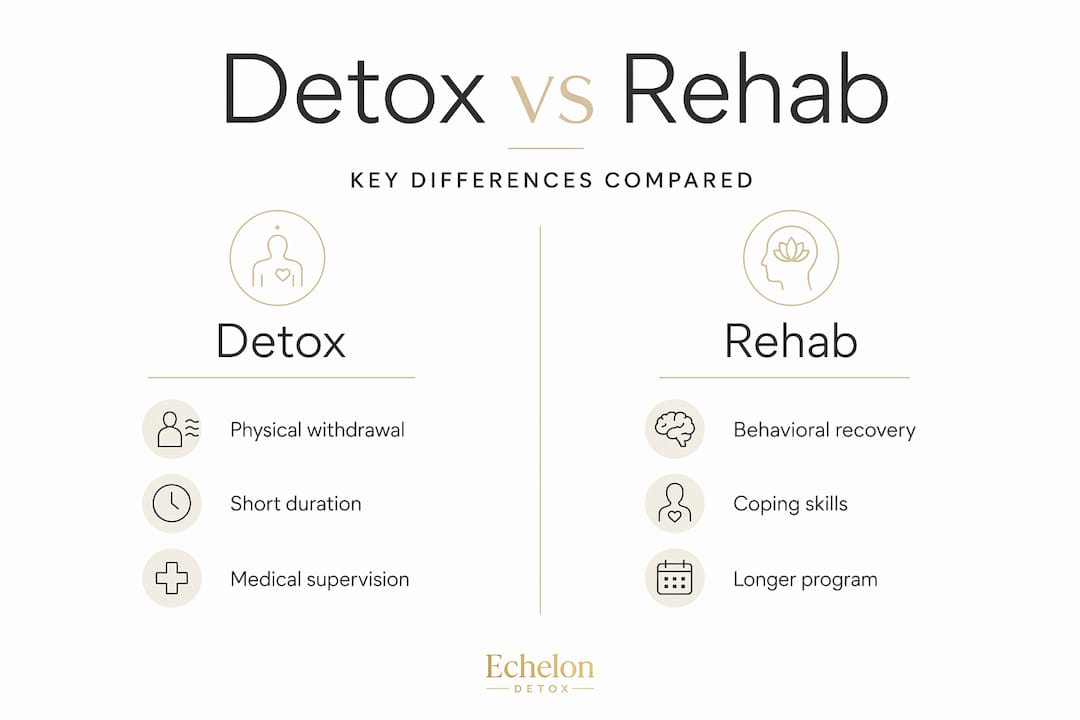
One of the most persistent misconceptions in addiction treatment is that completing detox means completing treatment. It does not. Leaving after detox without follow-up care greatly increases the chances of relapse. The discomfort of withdrawal is gone, but every underlying driver of the addiction remains fully intact. Without rehab, most people return to use within weeks, and sometimes days.
Pro Tip: Ask any detox program whether they have a structured transition plan to rehabilitation before you commit. A reputable program will have clear referral pathways and will begin discussing your rehab options before your detox is even complete.
Cost and insurance coverage differ across detox and rehab as well. Many insurance plans cover medically necessary detox as an acute care event. Rehab coverage varies more widely based on the level of care, duration, and whether the program is in-network. Reviewing your benefits before treatment begins protects you from unexpected financial surprises.
Deciding what you need: detox, rehab, or both
Most people who need addiction treatment need both detox and rehab, though not always in the same facility or program. The decision about where to start and what level of care to pursue should be guided by medical evaluation, not self-assessment alone.
Here is a practical framework for thinking through the process:
-
Assess physical dependence first. If you have been using alcohol, benzodiazepines, or opioids heavily and regularly, physical dependence is likely. Stopping abruptly without medical supervision carries real risks. Contact a physician or addiction medicine specialist before stopping on your own.
-
Get a professional evaluation. Care level decisions should be based on symptom severity and medical history, not simply on willingness to stop. A qualified clinician will assess your withdrawal risk and recommend the appropriate setting, whether inpatient, outpatient, or supervised home detox.
-
Plan for rehab before detox ends. Detox programs that include a transition plan to rehab produce measurably better outcomes. Do not wait until detox is over to start thinking about next steps.
-
Choose the right rehab level of care. Options range from residential inpatient programs to intensive outpatient programs (IOP) and standard outpatient therapy. The right choice depends on your home environment, the severity of your addiction, your work and family obligations, and whether you have co-occurring mental health conditions.
-
Build an aftercare plan. Recovery does not end when rehab ends. Aftercare options include ongoing outpatient therapy, support groups like Alcoholics Anonymous or SMART Recovery, sober living arrangements, and continued medication management where appropriate.
The most effective treatment paths are not linear checklists. They are personalized plans built around your specific situation. Understanding the benefits of detox vs rehab as distinct and connected phases gives you the clarity to have more informed conversations with medical providers and make decisions with confidence.
My perspective on why both phases matter more than people realize
I've seen too many people complete detox and feel genuinely proud of themselves, which they should, only to walk back into the same environment, same relationships, and same emotional pain without any support structure. Within weeks, they are back where they started. Sometimes worse.
What I've learned is that detox gets the credit it deserves for being medically difficult and necessary. But it is also the phase where people feel well enough to think they are done. The physical relief of getting through withdrawal is real, and it can feel like recovery. It is not. It is the beginning of recovery.
The individualized treatment piece matters more than most people appreciate. Someone stepping out of a high-pressure executive role, someone managing untreated anxiety, and someone with a 20-year substance history all need very different rehabilitation plans. A generic 30-day residential program fits some people well and others not at all. The question to ask is not just what type of treatment is available but what type of treatment actually fits your life.
My genuine belief, informed by everything I have encountered working in this space, is that people who treat detox and rehab as a connected continuum from the start have a fundamentally different relationship with recovery than those who treat detox as a standalone event. The mindset going in shapes the outcome more than most realize.
— Nichol
Take the right first step with expert care
If you are trying to understand the detox vs rehabilitation difference because someone you care about is struggling, or because you are considering treatment yourself, that clarity is not just academic. It is the foundation of a good decision.

Echelondetox provides physician-guided, in-home detox services for individuals who need medically supervised withdrawal in a private, dignified setting. Our licensed physicians and nurses deliver 24/7 care tailored to your specific health history and recovery needs. We also work closely with clients to plan next steps in rehabilitation so that detox becomes the beginning of lasting recovery, not the end of treatment. Reach out to learn how Echelondetox can support you through every stage of this process.
FAQ
What is the main detox vs rehabilitation difference?
Detox is a short, medically supervised process that manages physical withdrawal symptoms, while rehabilitation is a longer treatment phase focused on behavioral, psychological, and emotional recovery. Both are distinct and necessary parts of addiction treatment.
Can you go to rehab without doing detox first?
If you are physically dependent on a substance, attempting rehabilitation without medical detox first can be unsafe and less effective. Acute withdrawal reduces the brain's ability to benefit from counseling and therapy, making detox a necessary precursor.
How long does each phase typically last?
Detox generally lasts 3 to 10 days depending on the substance and severity of dependence. Rehabilitation programs typically run 30 to 90 days or longer, with ongoing outpatient support continuing well beyond that.
Is detox alone enough to treat addiction?
No. Detox addresses physical dependence but does not treat the psychological, emotional, or behavioral patterns that sustain addiction. Without rehabilitation after detox, the risk of relapse remains very high.
What type of detox setting is right for me?
The appropriate setting depends on your withdrawal risk level, medical history, and personal circumstances. A licensed physician specializing in addiction medicine can assess your situation and recommend inpatient, outpatient, or supervised home detox based on what is medically appropriate for you.