

Detox is defined as a structured physiological and neurological reset that clears toxic load, rebalances brain chemistry, and rebuilds the cognitive capacity that chronic stress and substance use erode. For professionals experiencing burnout, performance decline, or substance-related impairment, understanding how detox restores professional functioning is the first step toward reclaiming a sustainable career. The process spans two distinct but complementary domains: medically supervised detoxification for substance-related conditions, and structured digital detox for cognitive overload. Both address the same underlying problem. When your brain is depleted, your work suffers. When your work suffers long enough, your career follows. Echelondetox works with professionals at exactly this crossroads, providing physician-guided pathways back to clarity, focus, and performance.
How detox restores professional functioning through brain chemistry
The science behind detox and work performance is specific and measurable. Burnout impairs cognitive function and emotional regulation in ways the individual often cannot detect from the inside. This is the most dangerous feature of professional depletion: you lose the ability to accurately assess your own impairment while continuing to make high-stakes decisions.
Medically supervised detoxification works by clearing the substances or stress hormones that disrupt neurotransmitter balance, particularly dopamine, serotonin, and cortisol. When these systems are dysregulated, the prefrontal cortex, the brain region responsible for planning, judgment, and impulse control, operates at reduced capacity. Clinically guided detox protocols restore this balance through a combination of pharmacological support, sleep restoration, and nervous system regulation.

The results are clinically significant. Cognitive function improves by up to 40% within 90 days of completing a properly structured detox protocol. That figure represents the difference between a professional who misses critical details and one who leads with precision. Sleep architecture also normalizes during detox, which compounds the cognitive benefit. Deep sleep is when the brain consolidates memory, processes emotional experience, and clears metabolic waste through the glymphatic system.
Key neurological and physiological changes that detox initiates include:
- Restored dopamine sensitivity: Substance use and chronic stress both blunt the brain's reward circuitry. Detox allows receptor sensitivity to recover, which improves motivation and follow-through.
- Reduced cortisol dysregulation: Chronic stress elevates cortisol to levels that damage the hippocampus, impairing memory and learning. Detox combined with structured recovery normalizes the stress response.
- Improved sleep architecture: Restorative sleep returns within weeks of detox, directly improving working memory, attention span, and emotional stability.
- Emotional regulation recovery: The amygdala, which governs threat response, becomes less reactive as the nervous system stabilizes, reducing reactive decision-making and interpersonal conflict at work.
Successful executive detox integrates medically supervised detoxification with burnout recovery focused on sleep restoration and gradual rebuilding of cognitive and emotional capacity. This is not a passive process. It requires clinical structure and pacing.
Does digital detox actually improve workplace productivity?
Digital detox is the practice of deliberately reducing or eliminating technology use for a defined period to allow cognitive recovery and restore attentional capacity. It is the recognized organizational term for what many professionals experience as simply "unplugging," and it addresses a distinct but equally damaging form of depletion.
Constant connectivity fragments attention in ways that compound over time. Every notification, unread message, and background alert competes for working memory. The cumulative effect is a state of low-grade cognitive exhaustion that professionals often misattribute to workload rather than technology exposure. Limiting evening screen time improves sleep quality and daytime focus, which means the damage extends beyond work hours into recovery time.
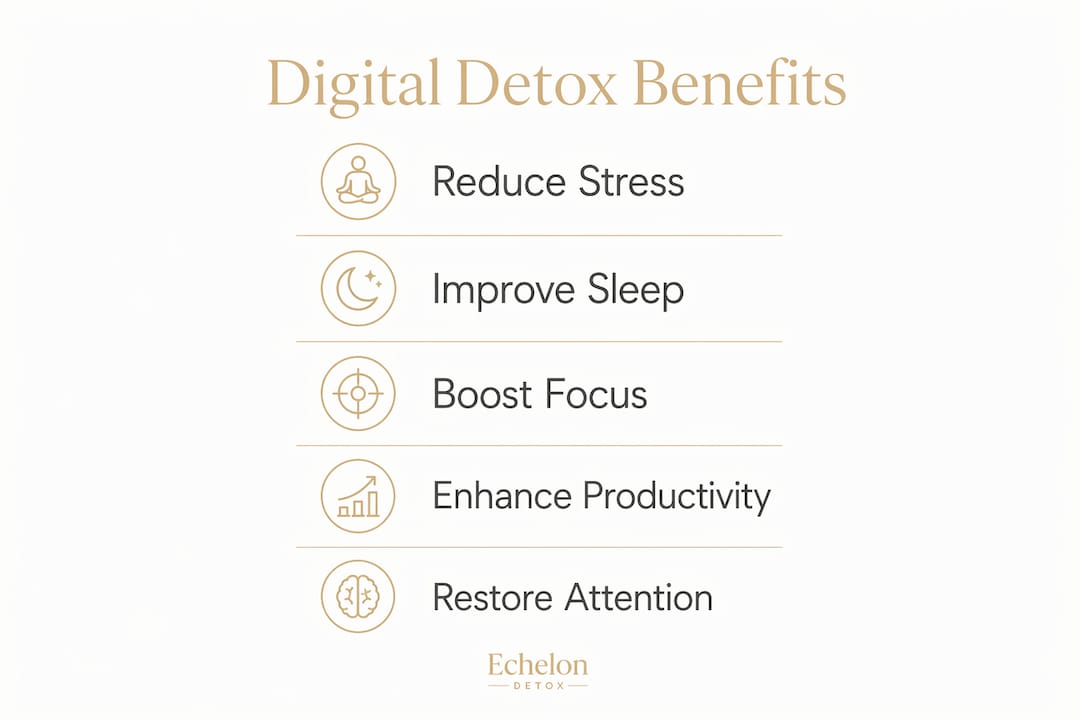
The organizational evidence is compelling. When Harvard Business Review analyzed meeting reduction, productivity rose 71% when meetings were cut by 40%. That finding reflects the same principle as digital detox: removing cognitive interruptions restores the deep work capacity that drives real output. Team-level disconnection produces stronger wellbeing effects than individual efforts alone, which means organizational adoption matters more than personal willpower.
Practical digital detox strategies that work for high-pressure professionals:
- Scheduled no-notification blocks: Designate 90-minute windows with all alerts silenced. This aligns with ultradian rhythm cycles and protects deep work.
- No-meeting mornings: Reserve the first two hours of the workday for focused, uninterrupted work before entering reactive communication modes.
- Notification hygiene audit: Remove all non-essential app notifications from your phone and desktop. Most professionals find they have 40 to 60 more notifications enabled than necessary.
- Device-free recovery periods: Establish phone-free meals, walks, and the first 30 minutes after waking. These windows allow the default mode network to reset.
- Company-wide unplug days: Organizational adoption removes the social pressure to stay available, which is the primary barrier to individual digital detox success.
Pro Tip: Five minutes of break per hour is the optimal recovery interval for cognitive performance. A single long break at the end of the day does not produce the same restoration. Build micro-breaks into your calendar as non-negotiable appointments.
Comparing detox options for high-functioning professionals
Not all detox methods address the same problem, and choosing the wrong approach for your situation delays recovery. The three primary detox options relevant to professionals are medically supervised detoxification, in-home concierge detox, and structured digital detox. Each serves a different clinical and practical need.
| Detox method | Primary benefit | Key drawback | Best suited for |
|---|---|---|---|
| Medically supervised detox (facility) | Highest clinical safety and monitoring | Requires absence from work; privacy concerns | Severe substance dependence requiring 24/7 observation |
| In-home concierge detox | Privacy, comfort, and clinical care without facility admission | Higher cost; requires stable home environment | Executives and professionals prioritizing discretion and flexibility |
| Digital detox (individual) | Immediate cognitive recovery; low barrier to entry | Limited effect without organizational support | Professionals with burnout from technology overload |
| Digital detox (organizational) | Removes social pressure; produces stronger wellbeing outcomes | Requires leadership buy-in and cultural change | Teams and organizations with systemic connectivity problems |
In-home detox deserves particular attention for professionals. In-home detox options allow medically supervised withdrawal management without the career exposure that facility admission can create. For executives, public figures, and licensed professionals, the ability to detox without leaving your home environment removes one of the most significant barriers to seeking care.
Pro Tip: If you are evaluating in-home detox for privacy, confirm that the provider offers 24/7 physician and nursing coverage, not just daily check-ins. Withdrawal from alcohol or benzodiazepines carries medical risk that requires continuous clinical oversight, not periodic monitoring.
The most effective approach for professionals dealing with substance-related burnout combines in-home medical detox with a structured reintegration plan. Detox alone is not the endpoint. It is the clinical foundation on which cognitive and professional recovery is built.
How detox benefits translate directly into work performance
The connection between detox and workplace productivity is not theoretical. It is measurable across specific performance dimensions that matter to professionals and their organizations.
Reduced cognitive errors are the most immediate benefit. When the prefrontal cortex is no longer suppressed by substance use, chronic stress hormones, or technology-induced fragmentation, decision quality improves. Professionals report fewer missed details, better risk assessment, and more deliberate communication within weeks of completing detox.
Emotional regulation recovery follows closely. Burnout causes profound depletion of emotional capacity, which surfaces at work as irritability, withdrawal, and reactive conflict. As the nervous system stabilizes through detox, interpersonal effectiveness returns. This matters for leadership roles where emotional tone sets team culture.
The organizational return on investment is significant. Employees in wellbeing-prioritizing cultures are five times more engaged and loyal, with 97% expressing intent to stay compared to 20% in neglect cultures. That gap represents real costs in turnover, recruitment, and institutional knowledge loss. When organizations invest in detox-supportive policies, they are protecting their most expensive asset: experienced, high-functioning people.
Long-term professional sustainability requires more than completing detox. Structured return-to-work plans are critical to preventing relapse and sustaining the cognitive gains that detox produces. The return to a high-pressure environment is the highest-risk phase of recovery. Without clinical pacing and support structures, the same conditions that drove depletion will reassert themselves within weeks.
The professionals who sustain their recovery and career performance share one characteristic: they treat reintegration as a clinical process, not a personal willpower challenge. They return to work with adjusted workloads, defined boundaries, and ongoing support. They do not return to the exact conditions that preceded their breakdown.
Key takeaways
Detox restores professional functioning by resetting brain chemistry, improving sleep, and rebuilding the cognitive and emotional capacity that burnout and substance use deplete.
| Point | Details |
|---|---|
| Cognitive recovery is measurable | Properly structured detox protocols improve cognitive function by up to 40% within 90 days. |
| Digital detox requires organizational adoption | Team-level disconnection produces stronger wellbeing effects than individual effort alone. |
| In-home detox protects career privacy | Concierge detox allows medically supervised withdrawal without facility admission or professional exposure. |
| Reintegration is the highest-risk phase | Structured return-to-work plans with clinical pacing are critical to sustaining detox gains. |
| Wellbeing cultures retain talent | Employees in wellbeing-focused organizations are five times more engaged and dramatically more likely to stay. |
What I've learned about detox as a professional strategy
The professionals I respect most treat detox as a leadership decision, not a last resort. That reframe matters more than any clinical protocol. When you wait until performance has visibly collapsed, the recovery timeline is longer, the career damage is harder to reverse, and the personal cost is higher. Choosing to address depletion before it becomes crisis is not weakness. It is the same risk management thinking that defines good executive judgment in every other domain.
What most articles on this topic miss is the reintegration problem. Detox is the beginning of recovery, not the end. I have seen professionals complete rigorous, medically excellent detox programs and return to the same 70-hour weeks, the same unmanaged inboxes, the same cultures of constant availability, and relapse within months. The clinical gains from detox are real, but they are not permanent without structural change. The return to work must be designed, not defaulted into.
The stigma around detox in professional environments is real, and it is also shrinking. Taking detox as a proactive strategy breaks that stigma and prevents the kind of catastrophic professional failures that are far harder to recover from than a planned, discreet period of medical care. The professionals who speak most openly about their recovery, in appropriate contexts, tend to be the ones who have built the most durable careers afterward. Dignity and discretion are not opposites. You can protect your privacy and still make a courageous decision.
— Nichol
How Echelondetox supports your return to professional functioning
If you recognize yourself in this article, the next step does not require a facility, a leave of absence, or a public disclosure. Echelondetox provides physician-guided, 24/7 in-home detox care designed specifically for professionals who need medically excellent treatment without sacrificing privacy or career continuity.

Every Echelondetox program is built around your health history, schedule, and recovery goals. Licensed physicians and nurses provide continuous clinical oversight, and structured reintegration planning begins before detox ends. For executives, healthcare professionals, and public figures who cannot afford gaps in discretion, Echelon Detox offers the clinical rigor of supervised medical detox with the dignity of care delivered at home. Reach out to learn how a personalized detox plan can restore your focus, your health, and your career.
FAQ
How does detox improve focus and cognitive performance?
Detox removes the substances and stress hormones that suppress prefrontal cortex function, restoring the brain's capacity for planning, judgment, and sustained attention. Clinically guided protocols can improve cognitive function by up to 40% within 90 days.
What detox options are available for professionals who need privacy?
In-home concierge detox provides medically supervised withdrawal management without facility admission, protecting professional reputation and career continuity. Echelondetox offers 24/7 physician and nursing care delivered entirely in your home.
Is digital detox effective for burnout recovery at work?
Digital detox reduces technostress, improves sleep quality, and restores attentional capacity when implemented consistently. Organizational adoption, such as company-wide unplug days and no-meeting blocks, produces stronger results than individual effort alone.
How long does it take for detox to improve work performance?
Cognitive and emotional improvements begin within days of completing detox, with measurable gains in focus, decision-making, and emotional regulation appearing within the first few weeks. Sustained performance recovery depends on structured reintegration and ongoing support.
Why is the return to work after detox considered high-risk?
Returning to a high-pressure environment without clinical pacing reexposes the recovering professional to the same conditions that drove depletion, increasing relapse risk significantly. Structured return-to-work plans with adjusted workloads and defined support systems are the clinical standard for sustainable recovery.