

In-home drug detox in Columbia, SC is a medically supervised process that allows you to safely withdraw from substances with licensed physician oversight, without leaving your home or disclosing your situation to colleagues. The industry term for this service is concierge medical detox, and it combines clinical rigor with the privacy protections most professionals require. HIPAA federal law prohibits your treatment provider from disclosing any details to your employer or licensing board without your explicit consent. For attorneys, physicians, executives, and public figures across the Midlands region, that legal protection is often the deciding factor between seeking help and delaying it.
What is in-home drug detox in Columbia, SC?
Concierge medical detox is defined as physician-guided withdrawal management delivered inside a patient's private residence by a licensed medical team. Unlike a residential facility, there is no intake paperwork filed with a public institution, no shared ward, and no risk of being recognized by another patient or staff member. A licensed physician evaluates your health history, designs a personalized detox protocol, and a nurse or medical professional remains on-site to monitor your condition around the clock.
For Columbia, SC residents managing careers in law, medicine, finance, or government, this model resolves the core conflict: you need medical care, but you cannot afford public exposure. Concierge detox services are specifically designed to balance those two demands. The care is not a compromise. It is the same evidence-based withdrawal management used in clinical settings, delivered with a higher staff-to-patient ratio than most inpatient facilities can offer.

How to prepare for in-home detox in Columbia, SC
Preparation determines whether your detox is safe, comfortable, and legally protected. Four areas require attention before a licensed team arrives at your door.
Medical eligibility assessment
Not every individual is a candidate for home-based detox. A physician will review your substance use history, current health status, and withdrawal risk profile before approving the setting. Individuals with a history of seizures, delirium tremens, or severe cardiovascular conditions may require a higher level of care initially. Honest disclosure during this assessment protects you. It allows the medical team to prepare the right medications and monitoring protocols.
Insurance and payment options
Most major insurance plans in South Carolina cover medical detox under the Mental Health Parity and Addiction Equity Act, which requires insurers to treat substance use disorders on par with physical health conditions. Insurance verification typically takes 24 to 48 hours after submitting your information. That timeline matters because it means you can confirm coverage discreetly before committing to a program. Private pay options are also available for those who prefer no insurance record of treatment whatsoever.
Home environment setup
Your medical team will specify what the space requires: a private bedroom, reliable temperature control, access to a bathroom, and a quiet environment for rest and monitoring. You do not need medical equipment in advance. The team brings everything, including medications, monitoring devices, and emergency protocols.
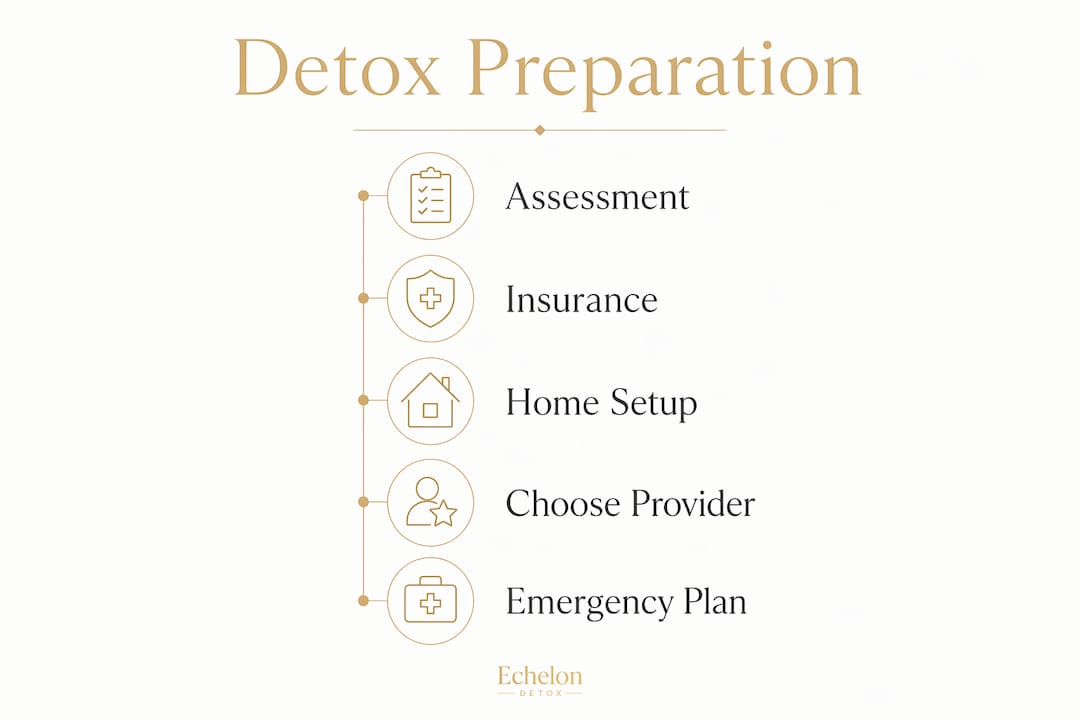
Choosing qualified providers
Clinicians recommend verifying staff-to-patient ratio and in-home team qualifications before commitment. Ask specifically whether the attending physician is board-certified in addiction medicine or emergency medicine, and whether the nursing staff holds active licensure in South Carolina. Single-patient concierge care allows minute-by-minute observation that is simply unavailable in group facility settings.
Pro Tip: Request written documentation of your provider's emergency response protocol before your detox begins. A qualified team will have a clear plan for transferring you to a hospital if a complication arises, and they will share it without hesitation.
How does the in-home detox process work step by step?
The process follows a defined clinical sequence, even though it takes place in your home. Understanding each stage reduces anxiety and helps you prepare practically.
-
Confidential intake consultation. A physician conducts a thorough clinical assessment by phone or secure video. This covers your substance use history, current medications, prior withdrawal experiences, and any co-occurring health conditions. Everything shared is protected under HIPAA.
-
Personalized detox plan. The physician designs a protocol specific to your substance, use history, and health profile. For alcohol withdrawal, this typically includes medications such as benzodiazepines to prevent seizures. For opioid withdrawal, buprenorphine or clonidine protocols are common. No two plans are identical.
-
Medical team arrival and setup. A licensed nurse or physician arrives at your home discreetly. There are no marked vehicles, no visible medical branding, and no interaction with neighbors or household staff unless you direct otherwise.
-
24/7 monitoring and symptom management. Vital signs, neurological status, and withdrawal severity are assessed on a continuous schedule. Medications are adjusted in real time based on your response. This is the stage where high staff-to-patient ratios prove their value. Unpredictable withdrawal symptoms require immediate clinical judgment, not a call to a distant on-call physician.
-
Maintained professional communication. Concierge detox prioritizes stability with discretion, supporting limited and secure communication access to minimize work disruption. Your medical team will work with your schedule to allow brief, controlled communication windows so you can manage urgent professional obligations without compromising your recovery.
-
Transition and follow-up planning. Withdrawal duration typically ranges from 3 to 10 days depending on substance and use history. Shorter detoxes risk incomplete withdrawal and higher relapse probability. Before the medical team departs, they will coordinate your next steps, whether that is outpatient therapy, a recovery support group, or continued physician follow-up.
| Stage | Typical duration | Key clinical activity |
|---|---|---|
| Initial assessment | 1 to 2 hours | Health history review, risk stratification |
| Active withdrawal phase | Days 1 to 4 | Medication management, vital sign monitoring |
| Stabilization phase | Days 4 to 7 | Tapering medications, symptom resolution |
| Transition planning | Final 24 hours | Aftercare coordination, follow-up scheduling |
Pro Tip: Keep a simple written log of your symptoms and sleep patterns during detox. This gives your physician precise data to adjust your protocol and gives you a record of your progress that can be genuinely motivating.
What are the benefits and risks compared to facility detox?
The comparison between in-home concierge detox and a traditional residential facility is not simply about comfort. It is about clinical outcomes, privacy protections, and career continuity.
"Planned medical detox is safer for careers than public crises triggering mandatory disclosures." — First City Recovery Center
HIPAA and federal privacy laws prohibit disclosure of your treatment details to employers or licensing boards without your explicit consent. A residential facility admission, by contrast, creates an institutional record that may surface in background checks or licensing reviews depending on your profession. In-home detox, managed through a private concierge provider, keeps that record entirely within your medical file.
| Factor | In-home concierge detox | Traditional facility detox |
|---|---|---|
| Privacy | No institutional record, HIPAA-protected | Institutional admission record created |
| Staff attention | Dedicated single-patient care | Shared staff across multiple patients |
| Professional continuity | Controlled communication access | Communication typically restricted |
| Comfort | Your own home, your own environment | Shared or clinical facility environment |
| Emergency response | Requires transfer protocol | On-site emergency resources available |
The one genuine advantage of a residential facility is immediate access to emergency medical infrastructure. A well-prepared in-home team mitigates this through clear transfer protocols and pre-established relationships with local Columbia, SC emergency services. The risk is real but manageable with the right provider. Private concierge detox programs address this through higher staff-to-patient ratios that ensure focused, continuous care.
The stigma reduction benefit of in-home detox is also clinically meaningful. Individuals who feel less exposed are more likely to complete the full detox process rather than leaving treatment early, which is one of the primary drivers of relapse.
What challenges should you expect and how to manage them?
Withdrawal is physically and psychologically demanding regardless of setting. Knowing what to expect reduces fear and helps you communicate clearly with your medical team.
Common withdrawal symptoms vary by substance but typically include:
- Alcohol withdrawal: Anxiety, tremors, sweating, elevated heart rate, and in severe cases, seizures or delirium tremens. Symptoms typically peak between 24 and 72 hours after the last drink.
- Opioid withdrawal: Muscle aches, nausea, vomiting, insomnia, and intense cravings. Symptoms are rarely life-threatening but are acutely uncomfortable without medication support.
- Benzodiazepine withdrawal: Similar to alcohol withdrawal in severity. This category carries the highest medical risk and requires the most careful physician oversight.
Attempting unmanaged withdrawal poses greater career risks than medically supervised detox. Severe unmanaged withdrawal can include seizures or delirium tremens, both of which may require emergency hospitalization and create exactly the kind of public record you were trying to avoid.
Warning signs that require immediate escalation to emergency care include: confusion or disorientation, high fever, uncontrolled vomiting, chest pain, or seizure activity. Your in-home medical team will recognize these signs before you do, which is precisely why 24/7 supervision matters.
After the acute withdrawal phase, anxiety, insomnia, and cravings often persist for days to weeks. This is called post-acute withdrawal syndrome, and it is the period when relapse risk is highest. Engaging a therapist, a recovery support group such as SMART Recovery or Alcoholics Anonymous, or a continuing care physician within the first week after detox significantly improves long-term outcomes.
Key takeaways
Medically supervised in-home detox in Columbia, SC delivers the same clinical safety as residential treatment with the privacy protections that professionals require to protect their careers and reputations.
| Point | Details |
|---|---|
| Medical supervision is non-negotiable | Unmanaged withdrawal risks seizures and delirium tremens, both of which require emergency care. |
| Insurance often covers treatment | The Mental Health Parity and Addiction Equity Act requires most South Carolina insurers to cover medical detox. |
| Privacy is legally protected | HIPAA prohibits disclosure to employers or licensing boards without your explicit written consent. |
| Duration is 3 to 10 days | Completing the full detox protocol reduces relapse risk and supports stable transition to aftercare. |
| Provider qualifications matter | Verify board certification in addiction medicine and active South Carolina nursing licensure before committing. |
Why in-home detox is the right call for Columbia professionals
I have spent years reviewing how professionals navigate addiction treatment, and the pattern is consistent. The individuals who delay care the longest are not the ones with the most severe problems. They are the ones with the most to lose publicly. A physician with an active license, an attorney mid-case, a financial advisor with client obligations. The fear of exposure is not irrational. It is a legitimate professional risk.
What I find most compelling about physician-guided home detox in South Carolina is that it removes the false choice between career protection and medical safety. You do not have to choose between getting well and staying employed. The legal framework under HIPAA is genuinely strong. Your treatment record does not reach your employer, your licensing board, or your colleagues unless you choose to share it.
The one mistake I see repeatedly is professionals attempting to manage withdrawal without medical support because they believe they can handle it, or because they want to avoid any record of treatment. Unmonitored withdrawal is where careers actually end. A medical crisis that triggers a 911 call creates a public record that no privacy law can seal. A planned, discreet in-home detox with a qualified team creates no such record.
My honest recommendation: verify your insurance coverage today, confirm your provider's physician credentials, and do not wait for a crisis to make the decision for you. The earlier you engage medical support, the safer and shorter your detox will be.
— Nichol
Start your private in-home detox in Columbia, SC today

Echelondetox provides physician-guided, concierge in-home detox for individuals across Columbia, SC and nationwide. Every admission begins with a confidential consultation. Insurance verification is handled discreetly, typically within 24 to 48 hours, and your personalized treatment plan is developed before the medical team arrives at your door. There are no marked vehicles, no public records, and no compromise on clinical quality. Licensed physicians and nurses deliver 24/7 care tailored to your health history, your schedule, and your recovery goals. If you are ready to take the first step, Echelondetox is ready to support you with the dignity and discretion you deserve.
FAQ
What is in-home drug detox in Columbia, SC?
In-home drug detox, also called concierge medical detox, is a physician-supervised withdrawal process conducted inside your private residence by licensed medical professionals. It provides the same clinical safety as a residential facility while protecting your privacy and professional reputation.
Is in-home detox covered by insurance in South Carolina?
Most major insurance plans in South Carolina cover medical detox under the Mental Health Parity and Addiction Equity Act, with verification typically completed within 24 to 48 hours. Private pay options are also available for those who prefer no insurance record of treatment.
How long does in-home drug detox take?
Withdrawal typically takes between 3 and 10 days depending on the substance and your use history. Completing the full protocol rather than stopping early is critical for reducing relapse risk.
Can my employer find out about my in-home detox?
HIPAA and federal privacy law prohibit your treatment provider from disclosing any details to your employer or licensing board without your explicit written consent. A private concierge provider creates no institutional admission record that could surface in background checks.
How do I choose a qualified in-home detox provider in South Carolina?
Verify that the attending physician holds board certification in addiction medicine or emergency medicine and that all nursing staff hold active South Carolina licensure. Ask for the provider's written emergency transfer protocol before treatment begins.