
Deciding to address alcohol dependence takes real courage. For many Washington State residents, the fear of exposure stops them from taking that first step. Private alcohol detox Washington State services exist precisely because that fear is valid and because the medical stakes of withdrawal are too high to manage alone. This guide covers what private detox actually means, how Washington's privacy laws protect you, how to choose a physician-guided provider with confidence, and what to expect from the moment you make contact to the day you transition into aftercare.
Table of Contents
- Key takeaways
- Understanding private alcohol detox in Washington State
- Privacy protections and legal rights in Washington
- How to choose a physician-guided private detox provider
- What to expect during private alcohol detox
- Verification and post-detox steps
- My perspective on privacy and medical safety in detox
- How Echelondetox supports your private detox in Washington
- FAQ
Key takeaways
| Point | Details |
|---|---|
| Privacy laws are stronger than most people realize | 42 CFR Part 2 requires your written consent before almost any disclosure of your detox records. |
| Withdrawal can be medically dangerous | Alcohol detox lasts 3 to 10 days and carries risks including seizures that require 24/7 medical supervision. |
| Private detox differs significantly from rehab | Private detox services offer discreet admission, personalized care, and no shared patient environment. |
| Washington adds extra privacy protections | The My Health My Data Act extends consumer health data protections beyond federal HIPAA standards. |
| Accreditation matters more than marketing | Verifying licensure and accreditation is the single most reliable way to confirm quality and privacy compliance. |
Understanding private alcohol detox in Washington State
Private alcohol detox is medically supervised withdrawal management delivered in a setting that prioritizes confidentiality, individualized care, and clinical safety. It is not the same as rehabilitation. Detox alone manages withdrawal safely; it does not treat the underlying patterns of addiction. That distinction matters because it shapes what you should expect and what comes next.
What medically supervised detox actually involves
Alcohol withdrawal is one of the few substance withdrawal syndromes that can be fatal. Symptoms range from anxiety and tremors in the early hours to seizures and delirium tremens in severe cases. Medically supervised detox typically lasts 3 to 10 days with around-the-clock monitoring to catch and treat complications before they escalate.
In a private setting, that monitoring happens without the noise of a shared ward. A licensed physician assesses your health history, designs a medication protocol, and adjusts it in real time based on how your body responds.
Why Washington State detox options often lack privacy
Standard publicly funded detox programs in Washington operate under state oversight that can involve shared records systems, mandatory reporting in certain circumstances, and group intake processes. These structures serve important public health goals, but they are not designed with individual confidentiality as the first priority.
Private detox services vs. rehab facilities in Washington differ in a meaningful way. Rehab facilities typically involve group therapy, shared living spaces, and broader clinical teams, all of which increase the number of people who interact with your records and your story. Private detox centers keep that circle very small by design.
Here is what distinguishes a genuinely private detox experience:
- Discreet admission with no shared waiting areas or group intake
- A dedicated clinical team assigned exclusively to your care
- Strict limits on who can access your records
- No requirement to disclose your status to employers or insurers beyond what you authorize
Pro Tip: Ask any provider directly how many staff members will have access to your records and under what circumstances information would be shared without your consent. A trustworthy provider will answer this question without hesitation.
Privacy protections and legal rights in Washington
Understanding the legal framework is not just academic. It tells you exactly how protected you are and what questions to ask before you commit to a provider.
The difference between HIPAA and 42 CFR Part 2
Most people assume HIPAA is the strongest privacy protection available. It is not, at least not for substance use disorder treatment. 42 CFR Part 2 is stricter than HIPAA, requiring your explicit written consent before records from a covered program can be shared for treatment, payment, or operations. That is a higher bar than HIPAA's standard, which permits many disclosures without patient authorization.
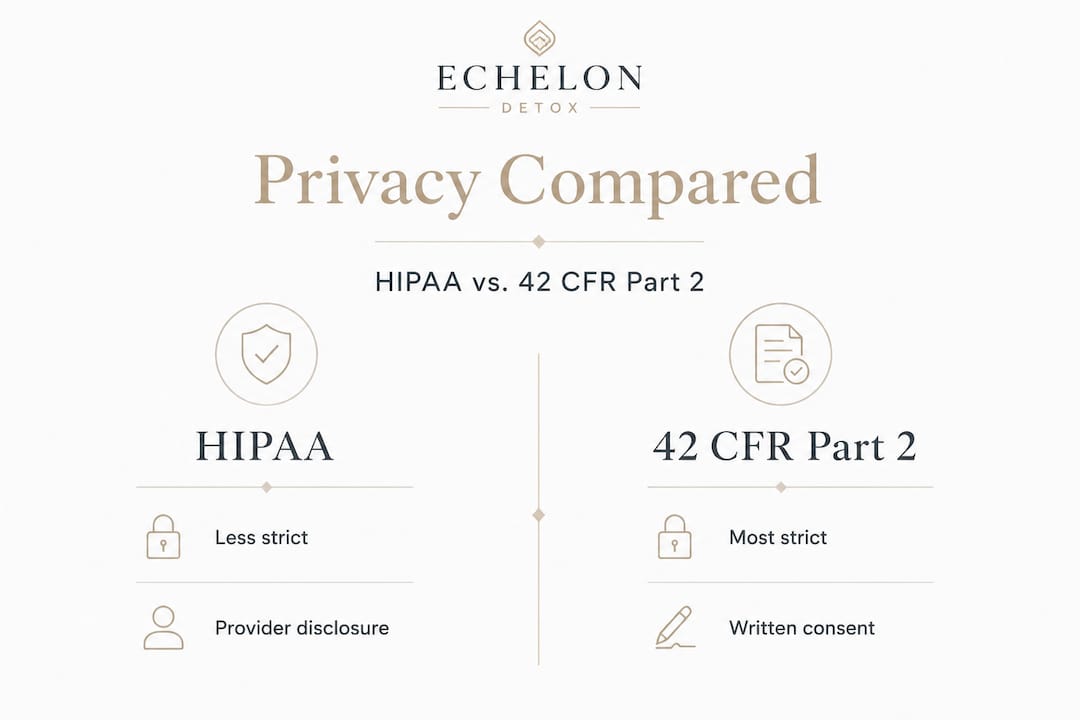
The practical implication: if you receive care at a program covered by 42 CFR Part 2, your records cannot be handed to your employer, your insurer, or even another treating physician without your signed permission. 42 CFR Part 2 exists specifically to prevent stigma and legal exposure for people seeking addiction treatment.
Washington State's additional protections
Washington goes further than federal law in several respects. The My Health My Data Act extends consumer health data privacy with special protections for mental health data, which includes substance use disorder treatment records. Washington law also gives patients the right to control and revoke authorizations for information sharing, with very limited exceptions.
| Protection | Federal (HIPAA) | Federal (42 CFR Part 2) | Washington State |
|---|---|---|---|
| Consent required for disclosure | Sometimes | Almost always | Almost always, with added consumer data rights |
| Covers substance use disorder records | Yes, broadly | Yes, specifically | Yes, with My Health My Data Act additions |
| Patient can revoke authorization | Yes | Yes | Yes, with stronger enforcement mechanisms |
| Employer access without consent | Prohibited | Prohibited | Prohibited |
"Strict confidentiality laws help reduce stigma and encourage more individuals in Washington to seek treatment without fear of exposure." — HHS, 42 CFR Part 2
One important legal context for Washington residents: Ricky's Law allows detention up to 120 hours for evaluation when someone is deemed dangerous due to substance use. This involuntary pathway is separate from private detox and underscores why proactively choosing private, voluntary care preserves both your autonomy and your privacy.
How to choose a physician-guided private detox provider
Choosing the right provider is where most people either protect themselves well or leave themselves exposed. Here is a step-by-step approach.
-
Verify licensure and accreditation. In Washington, look for Department of Health licensure and accreditation from the Joint Commission or CARF. These credentials confirm the provider meets clinical and ethical standards. Marketing language is not a substitute.
-
Confirm physician oversight. A private detox program should be led by a licensed physician, not just supervised by one on paper. Ask whether a doctor is available 24 hours a day or only on call.
-
Ask about the admission process. Discreet admission means no shared intake areas, no public-facing signage at the location, and a process that minimizes the number of people who know you are there.
-
Understand what telemedicine options exist. Washington has expanded same-day access to treatment through telemedicine, including a statewide buprenorphine hotline that connects patients to prescribing physicians quickly. Some private detox providers offer telemedicine-based intake to begin your care before you even arrive.
-
Review insurance and cost options carefully. Private detox programs may or may not accept insurance. If privacy is your primary concern, paying out of pocket eliminates the disclosure that comes with an insurance claim. Ask providers to walk you through both options.
-
Request a written privacy policy. Before you share any personal health information, ask for the provider's privacy policy in writing. Confirm it references 42 CFR Part 2 compliance if applicable.
Pro Tip: Choosing a provider with proper accreditation and licensure is the most reliable way to safeguard your privacy and receive high-quality medical care. Do not skip this step because a facility seems reputable or well-designed.
What to expect during private alcohol detox
Knowing what the experience looks like reduces fear and helps you prepare practically.
The clinical process
Your care begins with a thorough medical assessment covering your drinking history, current health status, and any medications you take. From that baseline, your physician designs a withdrawal management protocol. Benzodiazepines such as diazepam and lorazepam are the most commonly used medications in alcohol detox because they reduce the risk of seizures and ease the intensity of withdrawal symptoms.
Monitoring continues around the clock. Vital signs, symptom scores, and medication response are tracked and adjusted as your withdrawal progresses. In a private setting, this happens with a small, consistent team rather than rotating shift staff who do not know your history.
Withdrawal symptoms and timeline
| Timeframe | Common symptoms | Medical priority |
|---|---|---|
| 6 to 24 hours | Anxiety, tremors, nausea, insomnia | Baseline monitoring, medication initiation |
| 24 to 48 hours | Elevated blood pressure, sweating, agitation | Seizure risk management |
| 48 to 72 hours | Peak risk for delirium tremens in severe cases | Intensive monitoring, possible IV medication |
| Day 4 onward | Gradual symptom reduction | Transition planning, psychological support |
Emotional symptoms are just as real as physical ones. Anxiety, low mood, and difficulty sleeping are common throughout the process. A private setting allows for more individualized emotional support because your care team is focused on you alone.
Privacy practices during your stay
Your information stays within your authorized care team. No updates go to family members, employers, or outside providers without your explicit written consent. This is both a legal requirement and a core operating principle for any reputable private detox program.
After detox is complete, your physician will discuss transition options with you. Detox is the beginning, not the endpoint of recovery. Connecting to ongoing therapeutic care, whether inpatient alcohol treatment in Washington or outpatient support, is where long-term recovery takes root.
Verification and post-detox steps
Once your detox is complete, a few deliberate steps protect both your privacy and your recovery trajectory.
-
Request your medical records. Washington law gives you the right to access your own records. Review them for accuracy and confirm that no unauthorized disclosures occurred during your stay.
-
Understand your authorization trail. Ask the provider for a log of any disclosures made during your treatment. Under 42 CFR Part 2, this information is available to you.
-
Choose aftercare with the same privacy standards. When transitioning to outpatient treatment or a support group, ask those providers the same questions you asked your detox provider. Privacy protections do not automatically transfer between programs.
-
Avoid oversharing on digital platforms. Recovery communities online can be genuinely supportive, but public posts create a permanent record. Washington's My Health My Data Act protects your health data held by companies, but it does not protect what you share voluntarily.
-
Keep your support circle intentional. Telling trusted people in your life can be healing, but do it on your timeline and on your terms. You are never obligated to disclose your treatment history.
My perspective on privacy and medical safety in detox
I've spent years watching people delay getting help because they are terrified of being seen. That fear is not irrational. For a professional, a parent, or anyone with a public-facing life, the idea that a colleague or neighbor might find out about a hospital stay or a rehab admission is genuinely threatening. I understand why that fear wins, at least temporarily.
What I've learned is that the fear of exposure and the need for medical safety are not in conflict. They point to the same solution: a private, physician-guided detox with a provider who treats confidentiality as a clinical responsibility, not an afterthought.
What I've seen go wrong is when people choose speed over verification. They find a facility that sounds discreet, skip the accreditation check, and discover later that their records were handled carelessly or that the medical oversight was thinner than promised. The urgency to get help is real. But taking two extra hours to verify licensure and ask hard questions about privacy practices is worth it every time.
My recommendation is this: treat the provider selection process with the same rigor you would apply to any major medical decision. Ask for credentials. Read the privacy policy. Confirm physician availability. Washington gives you strong legal protections. Make sure the provider you choose actually uses them.
— Nichol
How Echelondetox supports your private detox in Washington

Echelondetox was built for exactly this situation. If you are a Washington State resident who needs medically supervised alcohol detox and cannot afford to compromise on privacy, Echelondetox provides physician-guided, 24/7 in-home care delivered by licensed physicians and nurses who treat confidentiality as a clinical standard.
Every care plan is customized to your health history, withdrawal risk level, and personal circumstances. There are no shared spaces, no group intake processes, and no unnecessary disclosures. Care comes to you, in your home, on your terms. If you are ready to take the next step with a provider who combines clinical rigor with genuine respect for your dignity, explore private detox services at Echelondetox and speak with a care coordinator today.
FAQ
What is private alcohol detox in Washington State?
Private alcohol detox in Washington State is medically supervised withdrawal management provided in a confidential setting, typically a private facility or your own home, with a dedicated physician-led team and strict limits on information disclosure.
How is 42 CFR Part 2 different from HIPAA for detox patients?
42 CFR Part 2 is stricter than HIPAA for substance use disorder records, requiring your explicit written consent before almost any disclosure, including to other treating providers or insurers.
How long does private alcohol detox take?
Alcohol detox typically lasts between 3 and 10 days, depending on the severity of dependence and how your body responds to medical management.
Can I do private detox at home in Washington State?
Yes. Physician-guided in-home detox is available in Washington State through concierge services like Echelondetox, which provide 24/7 medical supervision in your own residence for maximum privacy and comfort.
Will my employer find out if I go through private alcohol detox?
Under 42 CFR Part 2 and Washington State law, your detox records cannot be shared with your employer without your explicit written consent. Choosing a private, out-of-pocket program further limits any insurance-related disclosures.