

Most people assume medical privacy is automatic. You see a doctor, your records stay private. Simple. But when it comes to substance use disorder (SUD) treatment, the rules are more layered, more protective, and more specific than standard medical privacy law. For executives, public figures, and professionals where a single disclosure could reshape a career or a legal case, understanding exactly how confidentiality works in private detox is not optional. It is essential. This article breaks down the legal frameworks, real-world protections, and practical steps you need to make a fully informed, confident decision about your care.
Table of Contents
- What makes private detox confidentiality unique?
- Core protections: How your privacy is safeguarded
- Exceptions: When privacy can legally be breached
- What recent legal changes mean for your treatment in 2026
- A behind-the-scenes reality: What true privacy looks like in high-end detox
- Explore discreet private detox options
- Frequently asked questions
Key Takeaways
| Point | Details |
|---|---|
| Part 2 covers SUD privacy | Confidentiality protections for private detox are stricter than standard HIPAA privacy rules. |
| Consent is essential | Your written approval is needed before any treatment or identity information is shared. |
| Exceptions exist | Emergencies and certain legal mandates may allow disclosures without prior consent, but these are rare. |
| 2026 updates streamline care | New laws allow for single-consent disclosures, making collaboration easier for your care team. |
| Enforcement provides assurance | Strong penalties now apply for privacy breaches, backing up legal safeguards with real consequences. |
What makes private detox confidentiality unique?
To understand what makes private detox truly private, let's clarify the unique legal frameworks at play.
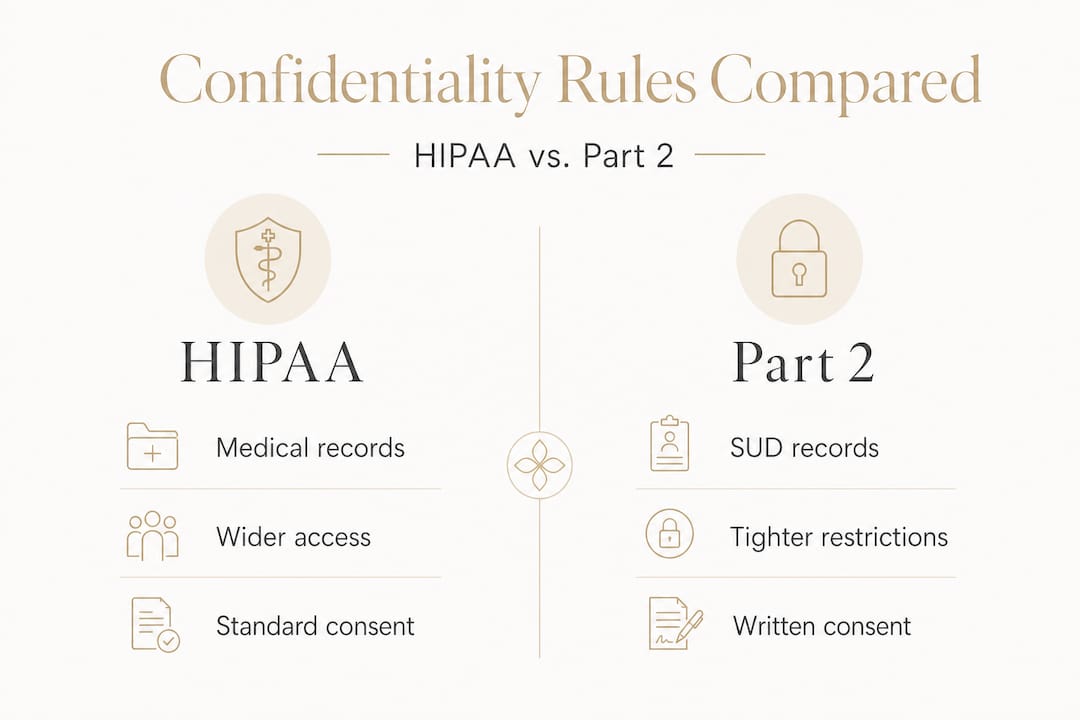
Most people are familiar with HIPAA, the Health Insurance Portability and Accountability Act, which governs the privacy of general medical records. But SUD treatment operates under a separate, stricter federal law. Private detox confidentiality for substance use disorder treatment is primarily governed by 42 CFR Part 2, which provides stricter protections than HIPAA for SUD patient records in federally assisted programs.
Why does this distinction matter? Because Part 2 was specifically designed to address the unique stigma and legal risks associated with SUD treatment. Congress recognized decades ago that people would avoid seeking help if their records could be freely shared with employers, law enforcement, or courts. The result is a law that goes further than HIPAA in nearly every meaningful way.
Here is what sets Part 2 apart from standard medical privacy:
- Stricter consent requirements: Any disclosure of SUD records requires written patient consent in most situations, not just a general authorization.
- No routine sharing: Unlike HIPAA, Part 2 does not allow routine sharing of records for treatment coordination without specific consent, though the 2026 updates have modified this somewhat.
- Existence is protected: A provider cannot even confirm that you are a patient without your written consent.
- Law enforcement restrictions: Police cannot access SUD records with a standard subpoena. A court order with specific legal standards is required.
- Broader scope: Part 2 covers any program that receives federal assistance, which includes most licensed treatment facilities.
"The protections under 42 CFR Part 2 exist because SUD treatment records carry unique legal, professional, and social risks that ordinary medical records do not. The law reflects a deliberate policy choice to prioritize patient safety over administrative convenience."
Pro Tip: When evaluating a private detox provider, do not simply ask "Is your program confidential?" Ask specifically: "Are you 42 CFR Part 2 compliant, and can you walk me through your consent protocols?" A provider who can answer that question in detail is one who takes privacy seriously at the operational level, not just on paper.
Core protections: How your privacy is safeguarded
Now that you know confidentiality is taken seriously, how is your privacy actively protected every step of the way?

Part 2 requires written patient consent for most disclosures of SUD records identifying diagnosis, treatment, or referral. Even acknowledging a patient exists is restricted without consent. This is not a technicality. It is a meaningful, enforceable standard that shapes every interaction a facility has with the outside world.
Here is how the consent process typically works in a high-quality private detox setting:
- Initial intake review: Before any treatment begins, you receive a detailed explanation of your privacy rights under both Part 2 and HIPAA.
- Written consent forms: You sign specific, itemized consent forms that identify exactly who can receive what information, for what purpose, and for how long.
- Revocable at any time: You can withdraw consent for any specific disclosure at any time, in writing.
- Scope limitations: Each consent form must specify the name or title of the person or organization authorized to receive the information, the type of information to be disclosed, and the purpose of the disclosure.
- Expiration date: Consent forms must include an expiration date or event, so your authorization does not remain open-ended indefinitely.
One important development is the TPO consent update. Recent 2024 updates effective in 2026 align Part 2 with HIPAA by allowing a single TPO (treatment, payment, operations) consent for redisclosure by HIPAA entities, except in legal proceedings against the patient. In plain language, this means that if you give one consent for your care team to coordinate your treatment, that single authorization can cover communication between your physicians, billing staff, and other licensed providers without requiring a separate form each time.
The following table outlines who can access your SUD records and under what circumstances:
| Party | Access with consent | Access without consent |
|---|---|---|
| Treating physicians | Yes | Only in medical emergencies |
| Family members | Only if you authorize | No |
| Employer | Only if you authorize | No |
| Attorney (yours) | Only if you authorize | No |
| Law enforcement | Only if you authorize | Requires court order |
| Insurance/billing | Yes, via TPO consent | No |
| Researchers/auditors | No | Yes, with strict anonymization |
| Other treatment programs | Yes, via TPO consent | No |
Pro Tip: Request a copy of the facility's consent form before you commit to treatment. Review it carefully. A well-constructed form will be specific, itemized, and clearly limited in scope. Vague or overly broad consent language is a warning sign worth taking seriously.
Exceptions: When privacy can legally be breached
While protections are strong, there are specific, rare exceptions every patient should understand.
Knowing the exceptions is not cause for alarm. It is simply responsible preparation. Disclosure without consent is permitted in a narrow set of circumstances including medical emergencies, crimes on premises, court orders (which are stricter than subpoenas), audits, research, and preventing multiple enrollments.
Here is a clear breakdown of the recognized exceptions:
- Medical emergencies: If your life or another person's life is at immediate risk, providers may share necessary information with emergency personnel. The disclosure is limited to what is needed for the emergency.
- Crimes on premises: If a crime is committed at the facility or against staff, limited information may be reported to law enforcement.
- Court orders: A court can order disclosure, but the legal standard is higher than a standard subpoena. The court must find good cause, weigh privacy interests, and limit the scope of any order.
- Audits and evaluations: Government agencies overseeing federally assisted programs may access records for oversight purposes, with strict anonymization requirements.
- Research: Approved research programs may access de-identified records under controlled conditions.
- Preventing multiple enrollments: Programs may share limited information to verify a patient is not simultaneously enrolled in conflicting treatment programs.
Mandated reporting exceptions such as child abuse represent a key edge case where facilities must balance privacy with public safety duties. If a provider learns of child abuse or neglect in the course of treatment, they may be legally required to report it, even if the information came from a protected SUD record.
The comparison below clarifies when consent is and is not required:
| Scenario | Consent required? |
|---|---|
| Sharing records with your personal physician | Yes |
| Disclosing to your employer | Yes |
| Reporting to law enforcement (routine) | Yes |
| Medical emergency disclosure | No |
| Court-ordered disclosure | No (but high legal threshold) |
| Mandated child abuse reporting | No |
| Research with anonymized data | No |
| Audit by oversight agency | No |
"Even in situations where disclosure is legally permitted without consent, providers are required to limit the information shared to the minimum necessary for the stated purpose. Blanket disclosure is never authorized under Part 2."
Understanding these exceptions gives you realistic expectations. The vast majority of patients in private detox will never encounter a situation where these exceptions apply. But knowing they exist, and knowing the legal safeguards that still surround them, allows you to enter treatment with clarity rather than uncertainty.
What recent legal changes mean for your treatment in 2026
With legal rules evolving, here is what high-profile clients need to know about changes and their practical impacts in 2026.
The most significant shift in SUD privacy law in a generation took effect in 2026. The 2024 updates now effective in 2026 align Part 2 with HIPAA by allowing a single TPO consent for redisclosure by HIPAA entities, with one critical carve-out: this streamlined consent cannot be used in legal proceedings against the patient.
What does this mean for you in practical terms?
- Simpler care coordination: Your detox physician, specialist, and follow-up care team can communicate more efficiently under a single consent authorization. You no longer need to sign a separate form for every provider interaction.
- Core protections remain intact: The anti-prosecution safeguard is explicitly preserved. Information shared under a TPO consent cannot be used against you in criminal or civil proceedings.
- Enforcement has teeth now: Enforcement under the Office for Civil Rights began in 2026 with HIPAA-aligned penalties, meaning facilities that violate Part 2 now face the same financial consequences as HIPAA violators. This is a meaningful deterrent.
- No documented breach epidemic: There are no published empirical breach rates specific to private detox programs. The legal framework, combined with new enforcement authority, provides a strong structural basis for confidence.
- Ongoing legal alignment: The 2026 changes reflect a broader policy goal of making SUD treatment records easier to manage clinically while keeping the most sensitive legal protections firmly in place.
The practical effect for high-profile individuals is significant. You can now receive coordinated, medically excellent care across multiple licensed providers without signing a stack of separate consent forms at every step. And the protection that matters most, the one that prevents your treatment records from being weaponized in legal proceedings, remains fully intact.
A behind-the-scenes reality: What true privacy looks like in high-end detox
Laws provide the floor. But what do the best private detox experiences actually offer in real-world confidentiality?
Here is the honest answer: compliance with 42 CFR Part 2 is necessary, but it is not sufficient for clients whose privacy needs are genuinely elevated. The harmonization of Part 2 with HIPAA eases care coordination while retaining anti-prosecution safeguards, but legal compliance alone does not address the full spectrum of privacy risks that executives, public figures, and high-profile professionals face.
Consider what legal frameworks cannot cover. A law can prohibit a facility from disclosing your records. It cannot prevent a staff member from recognizing you and mentioning it to a friend. It cannot stop a family member from sharing information you disclosed voluntarily during a phone call. It cannot manage a situation where a journalist contacts the facility asking general questions that indirectly confirm your presence.
This is where the gap between regulatory compliance and genuine discretion becomes visible. The best private detox providers understand this distinction deeply. They build privacy into every layer of the operation, not just the paperwork.
What that looks like in practice:
- Staff selection and training: Personnel in elite private settings are vetted for discretion, trained in VIP-adjacent confidentiality protocols, and bound by professional and contractual obligations that go beyond standard HIPAA training.
- Physical privacy design: In-home detox services, like those offered by physician-guided concierge programs, eliminate the facility environment entirely. There is no front desk, no waiting room, no other patients who might recognize you.
- Media and inquiry protocols: Reputable providers have clear, practiced procedures for handling media inquiries, legal requests, and family intervention scenarios that protect your interests at every point of contact.
- Transparent communication: The best providers will tell you exactly what their protocols are before you commit. If a provider is vague about how they handle a call from your attorney's office or a journalist, that vagueness is itself informative.
Our view is direct: true discretion means anticipating the situations that no law can fully cover and building operational responses to them before they arise. Compliance is the baseline. Genuine privacy is a practice, a culture, and a commitment that runs through every decision a provider makes.
Pro Tip: When consulting with a private detox provider, ask specifically how they handle inquiries from family members, legal representatives, and media. Ask what happens if someone contacts them claiming to be your personal physician. The quality and specificity of those answers will tell you more about their real-world privacy standards than any compliance certificate.
Explore discreet private detox options
If full discretion matters in your journey, finding the right provider is your next step.
Understanding the legal framework is empowering. Acting on that knowledge with the right support makes all the difference. For individuals who require the highest standards of privacy, personalized medical care, and genuine dignity throughout the detox process, the choice of provider is as important as the legal protections themselves.
At Echelon Detox, confidential private detox is not a feature. It is the foundation of everything we do. Our physician-guided, in-home concierge model means your care happens in your own environment, on your terms, with licensed medical professionals who are selected and trained for exactly the level of discretion you require. Every plan is customized. Every interaction is protected. And every step of your recovery is supported with the clinical rigor and compassionate care you deserve. Reach out for a confidential consultation and take the first step with complete confidence.
Frequently asked questions
Are private detox records more confidential than general medical records?
Yes, SUD records in private detox are protected by 42 CFR Part 2, which is stricter than standard HIPAA rules, including restrictions on even acknowledging a patient's existence without consent.
Can a private detox facility disclose my treatment to my employer or attorney without written consent?
No, a facility cannot share your information with employers or attorneys without your explicit written consent. Part 2 requires written consent for virtually all disclosures of SUD records, with only narrow legal exceptions.
What are the main exceptions to privacy in private detox?
Exceptions to consent include medical emergencies, certain court orders, crimes on premises, and mandated reporting obligations such as child abuse, though all exceptions are narrowly scoped.
How does the 2026 law update affect SUD privacy in private detox?
The updated law allows single TPO consent for broader care coordination disclosures, making treatment easier to manage across providers while explicitly preserving protections against use of records in legal proceedings.
Are there statistics about privacy breaches in private detox programs?
No published breach data exists specific to private detox programs, but enforcement began in 2026 with HIPAA-aligned financial penalties that create strong deterrence for any facility considering non-compliance.