

Deciding to stop drinking is one of the most significant decisions a person can make. But how you stop matters enormously. Many people assume that quitting alcohol at home simply means stopping and waiting it out. That assumption can be fatal. Unsupervised alcohol withdrawal carries risks that most people never see coming, including seizures that can strike without warning within hours of the last drink. A psychiatrist alcohol detox at home approach changes that equation entirely. With the right medical oversight, privacy, and personalized care, home detox can be both safe and genuinely dignified.
Table of Contents
- Key takeaways
- Understanding alcohol withdrawal symptoms and risks
- Criteria and preparation for home detox
- The step-by-step home detox process
- Common challenges and how psychiatrists adapt
- Verifying success and planning aftercare
- My perspective on psychiatric oversight in home detox
- How Echelondetox supports your private home detox
- FAQ
Key takeaways
| Point | Details |
|---|---|
| Medical supervision is non-negotiable | Alcohol withdrawal can be fatal without a psychiatrist monitoring symptoms and managing medications. |
| Not everyone qualifies for home detox | Patients with prior seizures or severe withdrawal history typically require inpatient care instead. |
| Benzodiazepines require a prescription | Evidence-based withdrawal medications must be prescribed and supervised by a licensed physician. |
| Detox is only the first step | Physical stabilization must be followed by behavioral and psychological addiction treatment to prevent relapse. |
| Privacy is fully achievable | Psychiatrist-led home detox delivers clinical-grade care without requiring a facility or public records of admission. |
Understanding alcohol withdrawal symptoms and risks
Most people do not know that alcohol withdrawal is one of only two withdrawal syndromes that can be directly fatal. Not uncomfortable. Not difficult. Potentially life-ending. That distinction matters when you are weighing your options.
The timeline of withdrawal follows a predictable pattern, but the severity does not. Symptoms typically begin within 6 to 24 hours after the last drink, peak between 24 and 72 hours, and can persist in milder forms for up to a week. The most dangerous window is that 24 to 72 hour range, when seizures and delirium tremens (DTs) become genuine risks.
Here is what the symptom progression looks like:
- Mild (6 to 24 hours): Tremors, sweating, nausea, elevated heart rate, mild anxiety
- Moderate (12 to 48 hours): Hallucinations (auditory or visual), significant agitation, elevated blood pressure
- Severe (24 to 72 hours): Grand mal seizures, delirium tremens, cardiovascular instability
Seizures affect 5 to 10% of people in untreated withdrawal. Delirium tremens occur in about 5% of cases, but carry a mortality rate as high as 37% without medical treatment. These are not rare edge cases. They are documented, predictable risks that a qualified psychiatrist for addiction is specifically trained to prevent.
"Delirium tremens represents one of the most medically complex withdrawal presentations in all of medicine. Its prevention depends entirely on early assessment and evidence-based pharmacological management." This is why waiting to see how symptoms progress on your own is not a safe strategy.
Signs that require immediate emergency transfer include continuous or repeated seizures, severe confusion or disorientation lasting more than a few minutes, chest pain, dangerously high or irregular heart rate, and high fever combined with agitation. Know these before you begin. Your care team should review them with you explicitly.
The gold standard treatment for alcohol withdrawal is benzodiazepines, specifically diazepam or lorazepam, prescribed and monitored by a licensed physician. These medications reduce seizure risk by over 90% when properly administered. Thiamine supplementation is also standard, given to prevent Wernicke's encephalopathy, a form of serious brain damage caused by the nutritional depletion that often accompanies heavy alcohol use.
Criteria and preparation for home detox
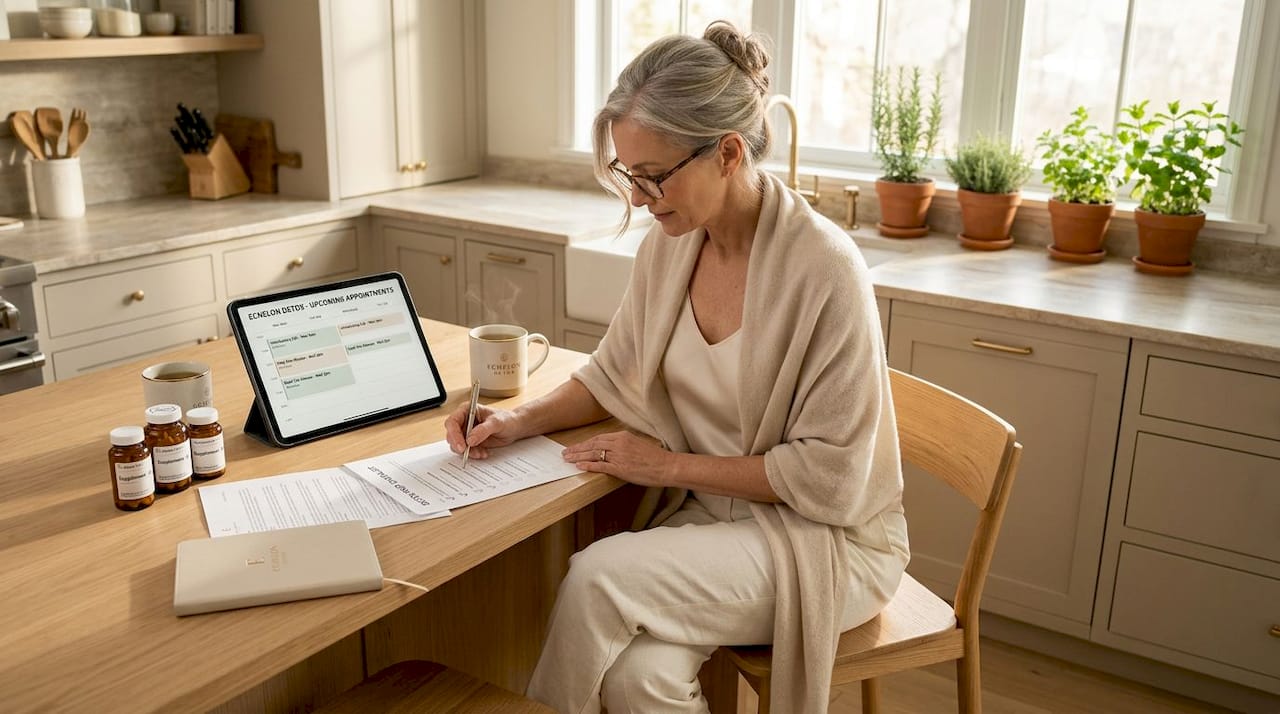
Home detox is a medical service called ambulatory withdrawal management. It is not a DIY process. The distinction matters legally, medically, and practically. You need a clinical assessment before starting, not after symptoms appear.
Who is a good candidate for home detox?
The following factors generally support safe candidacy for at-home detox guidance:
- Mild to moderate withdrawal history with no prior seizures or DTs
- Stable medical baseline without uncontrolled heart, lung, or liver conditions
- Reliable social support with a sober adult able to stay present during the acute withdrawal period
- Commitment to daily check-ins with the supervising psychiatrist or medical team
- Alcohol-free home environment secured before the first day of detox
Patients with prior complicated withdrawal, a history of seizures, delirium tremens, or significant medical comorbidities are typically not suited for home detox and require inpatient supervision instead.
Pre-detox setup checklist
| Preparation Step | Why It Matters |
|---|---|
| Full psychiatric and medical evaluation | Determines candidacy and informs the medication protocol |
| Remove all alcohol from the home | Reduces relapse risk during the most vulnerable hours |
| Identify a support person | Someone needs to observe you and contact medical help if needed |
| Fill all prescriptions in advance | Medication gaps during withdrawal are dangerous |
| Set up monitoring tools | Blood pressure cuff and thermometer allow the team to track vitals remotely |
Pro Tip: Before your first dose of any withdrawal medication, read through the emergency criteria your psychiatrist provides. Keep them visible, not stored on a phone. If your support person needs to act fast, a printed sheet on the refrigerator works better than searching a text thread.
The pre-detox psychiatric evaluation is where medical oversight becomes a true clinical asset. Your psychiatrist reviews your full alcohol history, prior withdrawal experiences, current medications, and any co-occurring conditions. That history shapes every decision in the protocol to follow.
The step-by-step home detox process
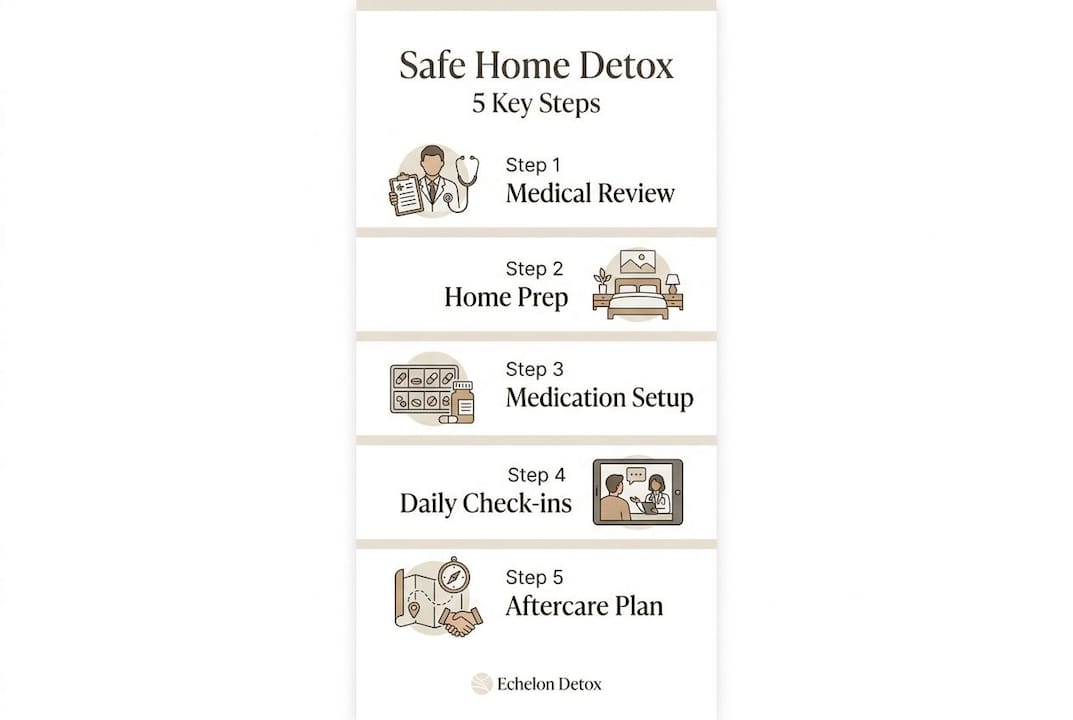
Once your evaluation is complete and your home is prepared, the detox process follows a structured, day-by-day rhythm. This is not improvised. Effective home detox requires daily monitoring, clear communication with the supervising psychiatrist, and adherence to a flexible benzodiazepine taper guided by symptom severity scales.
The Clinical Institute Withdrawal Assessment for Alcohol (CIWA-Ar) is the standard tool psychiatrists use to rate symptom severity and guide dosing decisions. Your support person can be trained to assist with this assessment at home.
Here is what a typical supervised home detox looks like over the first four days:
- Day 1 (Hours 0 to 24): Take the first scheduled benzodiazepine dose, often diazepam. Record baseline vitals. Your psychiatrist or medical team checks in by phone or video call. Mild symptoms are expected and manageable.
- Day 2 (Hours 24 to 48): The highest risk window. Dosing continues on a 4-3-2-1 taper schedule, with additional PRN (as-needed) doses available if CIWA-Ar scores climb. Daily contact with the psychiatrist is not optional during this phase.
- Day 3 (Hours 48 to 72): Symptoms often peak and then begin to ease. Appetite may start returning. Sleep remains disrupted. The psychiatrist adjusts doses based on your reported symptom scores.
- Day 4 and beyond: Tapering continues as symptoms resolve. Most physical withdrawal clears by days 5 to 7 for mild to moderate cases. Mental health support for detox continues through this phase, addressing anxiety, mood shifts, and sleep quality.
Never mix alcohol with your prescribed benzodiazepines. Even a single drink during this protocol can cause respiratory depression. That is a medical emergency, not a minor setback.
Pro Tip: Log your CIWA-Ar score, vitals, and any unusual symptoms at the same time every day and send them to your care team before your scheduled check-in. It gives your psychiatrist the full picture before the call, which makes those conversations more focused and clinically useful.
Understanding the medical detox protocol in advance reduces anxiety significantly. When you know what to expect on day two, you are less likely to panic when it arrives.
Common challenges and how psychiatrists adapt
Even well-prepared home detoxes encounter unexpected difficulties. Knowing what to anticipate helps you respond calmly rather than reactively.
The most frequent challenges during at-home detox include:
- Breakthrough withdrawal symptoms: Some patients experience a rebound of symptoms despite medication. This is not a failure. It signals that the taper needs adjustment, which your psychiatrist handles by modifying the dosing schedule.
- Severe sleep disruption: Alcohol suppresses REM sleep, and withdrawal reverses that effect dramatically. Vivid dreams, insomnia, and night sweats are common through day 5. Non-benzodiazepine sleep aids or antihistamines may be incorporated safely by your care team.
- Intense anxiety: Separate from withdrawal itself, underlying anxiety disorders often surface during detox. A psychiatrist for addiction recognizes this pattern and can introduce appropriate short-term support without compromising the detox protocol.
- Cravings and emotional distress: These are normal. They are also the primary reason mental health support for detox matters as much as the physical medication protocol.
Psychiatric supervision is particularly important when co-occurring conditions are present. Conditions like COPD, sleep apnea, and heart failure require careful benzodiazepine use because of the sedating effects these medications carry. A psychiatrist evaluates all of these factors before prescribing, not after a problem appears.
Honesty with your care team is a clinical requirement, not a courtesy. If you used alcohol during the detox, report it immediately. If symptoms feel worse than described, say so. The protocol is designed to be flexible, but only if your psychiatrist has accurate information to work with.
Verifying success and planning aftercare
Physical withdrawal resolution does not mean the work is done. It means one stage is complete.
You can reasonably consider the acute detox phase resolved when your CIWA-Ar scores have been consistently low for 24 to 48 hours, your vitals are stable, you are sleeping without severe disruption, and you are able to eat and stay hydrated without assistance. Your psychiatrist will confirm this through a final assessment.
What comes next is equally important. Detox addresses physical dependence but must be followed by behavioral and psychological treatment to prevent relapse. Patients without follow-on care relapse within days in many cases. Integrated care improves outcomes substantially.
| Post-detox option | What it addresses |
|---|---|
| Outpatient individual therapy | Underlying behavioral patterns and triggers for alcohol use |
| Medication-assisted treatment (MAT) | Craving reduction and relapse prevention using naltrexone or acamprosate |
| Group or peer support programs | Community accountability and shared recovery experience |
| Continued psychiatric care | Managing co-occurring mood, anxiety, or trauma-related disorders |
Psychiatrists often start maintenance therapy for alcohol use disorder soon after detox completion. The reasoning is clinical and practical. Motivation is high immediately post-detox, and leveraging that moment with medication and therapy significantly improves long-term sobriety chances. Your care team should have this conversation with you before your last detox day, not after.
My perspective on psychiatric oversight in home detox
I have seen what happens when people attempt to manage alcohol withdrawal without medical support. It is not simply uncomfortable. It is unpredictable in ways that are genuinely frightening.
What I've learned from working with patients in private home detox settings is that psychiatric involvement does not just reduce risk. It transforms the experience. When a patient knows that a licensed physician is reviewing their vitals each morning and a nurse is a phone call away, something shifts psychologically. Fear gives way to focus. That shift is clinically significant.
I believe one of the most damaging misconceptions about how to detox from alcohol is the idea that medical supervision is only for severe cases. The majority of individuals with alcohol use disorder, roughly 50%, do not develop severe withdrawal. But you cannot know in advance which category you fall into. That uncertainty alone makes psychiatric oversight the responsible standard, not an optional upgrade.
Privacy is also not a luxury concern. For executives, professionals, and public figures considering home alcohol detox, the ability to recover without a facility record or a public admission is a legitimate clinical consideration. It affects whether people seek care at all. I would rather someone pursue medically supervised home detox than delay treatment because they fear exposure.
Seek professional guidance early. Not when it feels critical. Early.
— Nichol
How Echelondetox supports your private home detox
If the protocols described in this article reflect the kind of care you have been searching for, Echelondetox was built precisely for this.

Echelondetox provides private, physician-guided alcohol detox at home with 24/7 in-home care from licensed physicians and nurses. Every detox plan is customized to your health history, withdrawal patterns, and lifestyle. You remain in your own home, in complete privacy, with clinical-grade medical support surrounding you throughout the process. The Mental Health Parity and Addiction Equity Act requires most insurance plans to cover medically supervised detox, so financial barriers may be lower than you expect. Echelondetox assists with insurance verification as part of onboarding. To learn more or begin a confidential evaluation, visit Echelondetox and take the first step on your own terms.
FAQ
What makes psychiatrist alcohol detox at home safe?
A psychiatrist prescribes and monitors evidence-based withdrawal medications, reviews your symptoms daily, and adjusts the protocol as needed. This clinical oversight eliminates the primary risk factors of unsupervised withdrawal.
Who is not a candidate for home alcohol detox?
Individuals with a history of seizures, delirium tremens, prior ICU-level withdrawal care, or significant uncontrolled medical conditions are not suited for home detox and require inpatient supervision.
How long does home alcohol detox take?
Acute physical withdrawal typically resolves within 5 to 7 days for mild to moderate cases. A psychiatrist confirms resolution through a final clinical assessment before the detox protocol is formally closed.
Does insurance cover psychiatrist-supervised home detox?
Most insurance plans are required by federal law to cover medically supervised detox at parity with other medical conditions. Echelondetox recommends verifying your specific coverage before beginning.
What happens after home detox is complete?
Detox resolves physical dependence but does not address the psychological dimensions of alcohol use disorder. Continued psychiatric care, outpatient therapy, or medication-assisted treatment are typically recommended immediately after detox to support lasting recovery.