

A detox support team is a multidisciplinary clinical group that includes physicians, registered nurses, mental health professionals, certified addiction counselors, and case managers working together to manage withdrawal safely and prepare patients for lasting recovery. This team structure, often called a multidisciplinary treatment team in clinical settings, is the standard of care for medically supervised detoxification. Understanding what does a detox support team include matters before you choose a program, because the composition and coordination of that team directly determines your safety, comfort, and chances of staying in recovery long term. Every role serves a distinct function, and together they cover the full spectrum of physical, psychological, and logistical needs during one of the most vulnerable transitions a person can face.
What does a detox support team include: core roles and responsibilities
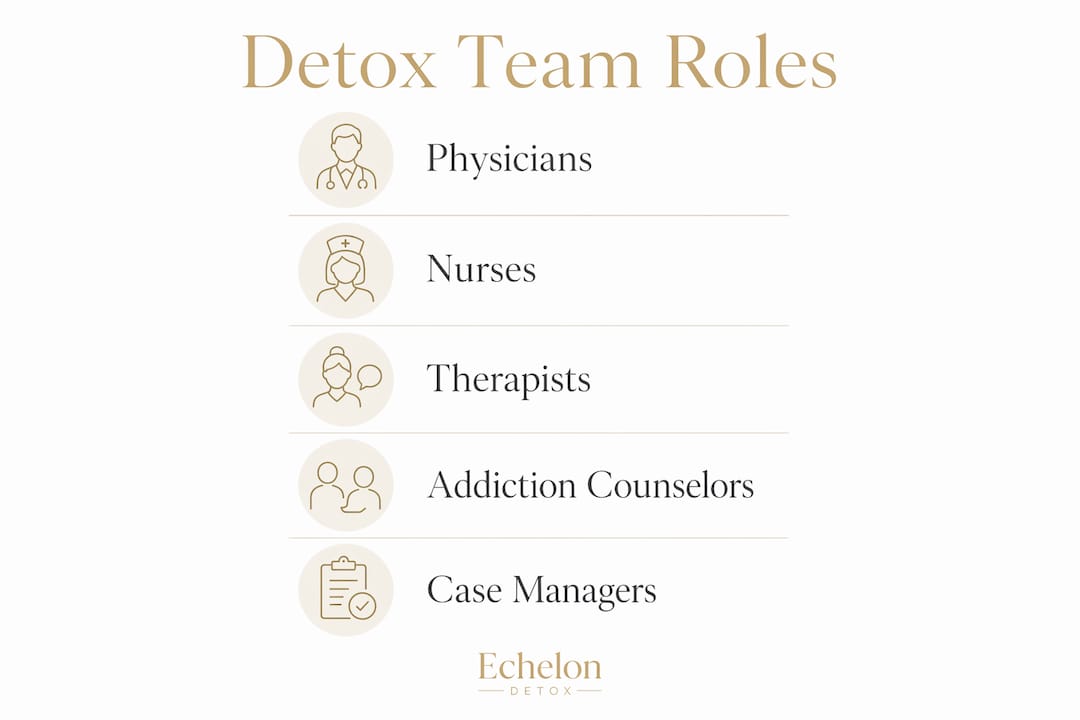
A well-structured detox team is built around five core disciplines, each with a defined scope of practice. According to Oxford Treatment Center, detox is a three-phase process led by a clinical team covering evaluation, stabilization, and transition to ongoing treatment. Each phase depends on a different combination of team members working in concert.
The components of detox support break down as follows:
- Physicians. The physician's role in detox centers on overseeing the entire medical protocol. They conduct clinical evaluations on admission, review lab results, authorize medication orders, and make escalation decisions when withdrawal becomes severe. Physician-led medication management makes withdrawal severity scores actionable. Nurses assess symptoms, but clinicians oversee dosing and escalation per protocol, per NurseChartingPro.
- Registered nurses. Nurses are the most consistently present members of the team. They monitor vital signs around the clock, administer medications, and apply standardized withdrawal scoring tools such as CIWA-Ar for alcohol withdrawal and COWS for opioid withdrawal. These scores are not just documentation. They trigger specific medication adjustments and reassessment intervals that keep patients safe.
- Mental health professionals. Licensed therapists, clinical social workers, and psychiatrists provide psychiatric screening and individual counseling. Their involvement is not supplementary. Psychiatric findings during detox are used to tailor immediate comfort strategies and long-term recovery planning, not treated as merely additional services.
- Certified addiction counselors. These professionals provide motivational support, psychoeducation about the recovery process, and crisis intervention when emotional distress peaks during withdrawal. They help patients understand what is happening physically and why continued treatment matters.
- Case managers. Case managers handle the logistics of recovery. They coordinate placement in inpatient rehabilitation, partial hospitalization programs, intensive outpatient programs, or medication-assisted treatment after detox ends. Case managers close the gap between detox and ongoing treatment, which is where relapse risk is highest.
Pro Tip: When evaluating a detox program, ask specifically which licensed professionals will be present on-site versus available by phone. On-site availability during acute withdrawal is a meaningful clinical distinction.
How the team assesses and monitors withdrawal symptoms

The assessment process begins before withdrawal symptoms peak. Comprehensive intake screening covers substance use history, current medications, vital signs, laboratory results, and psychiatric history within the first 24 to 48 hours. This information determines the patient's risk level and shapes the entire monitoring plan.
Monitoring during detox follows a structured sequence:
- Baseline vital signs. Blood pressure, heart rate, temperature, respiratory rate, and oxygen saturation are recorded at admission and tracked at regular intervals throughout detox. Elevated blood pressure and rapid heart rate are early indicators of escalating alcohol withdrawal that require immediate physician review.
- Urine toxicology screening. Specimen collection protocols follow strict clinical standards, including volume and temperature verification, to confirm which substances are present and guide safe medication choices.
- Withdrawal severity scoring. Nurses apply CIWA-Ar (Clinical Institute Withdrawal Assessment for Alcohol) or COWS (Clinical Opiate Withdrawal Scale) at scheduled intervals. Nursing documentation includes item scores, total scores, time of assessment, protocol action taken, and the scheduled reassessment time. This creates a real-time clinical record that guides every medication decision.
- Physician review and medication adjustment. Based on scoring results, the physician adjusts benzodiazepine dosing for alcohol withdrawal or buprenorphine dosing for opioid withdrawal. This is not a static prescription. It changes in response to the patient's current score.
- Reassessment loops. Patients with high withdrawal scores are reassessed more frequently, sometimes every one to two hours. Higher-risk patients require more intensive monitoring and faster clinical decisions, which is why thorough intake screening is the foundation of safe triage.
| Monitoring Tool | Substance | Purpose |
|---|---|---|
| CIWA-Ar | Alcohol | Scores 10 withdrawal symptoms to guide benzodiazepine dosing |
| COWS | Opioids | Scores 11 signs to guide buprenorphine or methadone dosing |
| Vital sign tracking | All substances | Detects cardiovascular instability requiring physician escalation |
| Urine toxicology | All substances | Confirms substance presence and guides safe medication selection |
Pro Tip: Ask any detox provider how often nurses reassess withdrawal scores and what triggers a physician call. Programs with clear escalation protocols demonstrate genuine clinical rigor, not just general supervision.
What supportive services the detox team provides beyond medical management
Medical stabilization is the floor, not the ceiling, of quality detox care. The services offered by a detox team extend well into psychological and logistical support that shapes whether a patient completes detox and moves into treatment.
Psychiatric screening within the first 24 to 48 hours is one of the most clinically significant services the team provides. Early psychiatric screening identifies depression, anxiety, trauma histories, and other co-occurring disorders that directly influence withdrawal presentation and medication decisions. A patient with untreated major depression requires a different counseling approach and aftercare plan than one without it.
Beyond screening, the team provides:
- Individual counseling sessions with licensed therapists or addiction counselors to address fear, shame, and ambivalence about recovery during the acute phase.
- Crisis intervention when emotional distress, suicidal ideation, or acute anxiety requires immediate clinical response rather than scheduled appointments.
- Psychoeducation to help patients understand the physical process of withdrawal, the purpose of each medication, and what recovery requires after detox ends.
- Mindfulness and relaxation practices in programs that incorporate them, which can reduce anxiety and improve sleep during withdrawal.
- Aftercare planning coordinated by case managers, covering inpatient rehabilitation, outpatient programs, sober living arrangements, and medication-assisted treatment options.
The value of this integrated approach is not theoretical. Detox is a medically supervised stabilization phase that prepares patients for recovery but is not sufficient alone for long-term success. The psychological and logistical support the team provides during detox directly increases the likelihood that a patient will accept and engage with the next level of care.
How the detox team ensures continuity of care after detox ends
Detox without a clear transition plan is an incomplete clinical intervention. Oxford Treatment Center explicitly notes that detox teams guide patients to inpatient or outpatient rehab because detox alone rarely produces lasting abstinence. The period immediately after detox ends carries significant relapse risk, and the team's coordination work during detox determines how well that transition goes.
How detox support works in the transition phase involves several coordinated steps:
- Case managers begin aftercare planning during detox, not after discharge, so placements and appointments are confirmed before the patient leaves.
- The clinical team shares a detailed summary of the patient's withdrawal course, medications, psychiatric findings, and treatment recommendations with the receiving program.
- Individualized treatment planning accounts for co-occurring mental health conditions, housing stability, employment obligations, and personal preferences about treatment modality.
- Dual-diagnosis patients, those with both a substance use disorder and a psychiatric condition, receive referrals to integrated treatment programs that address both conditions simultaneously rather than sequentially.
"Detox is the beginning of recovery, not the end of it. The team's job is to stabilize you medically and hand you off to the next level of care with everything the receiving team needs to continue your treatment without interruption."
The handoff quality between detox and ongoing treatment is a direct reflection of how well the team functioned as a coordinated unit. Programs that treat case management as an afterthought produce gaps in care. Programs that build transition planning into the detox process from day one produce better outcomes.
Key takeaways
A detox support team requires physicians, nurses, mental health professionals, addiction counselors, and case managers working as a coordinated unit to manage withdrawal safely and connect patients to ongoing treatment.
| Point | Details |
|---|---|
| Multidisciplinary team composition | Physicians, nurses, therapists, counselors, and case managers each serve a distinct clinical function. |
| Standardized withdrawal scoring | CIWA-Ar and COWS guide real-time medication adjustments and reassessment intervals for patient safety. |
| Early psychiatric screening | Identifying co-occurring disorders within 48 hours shapes both immediate care and long-term recovery planning. |
| Transition planning starts during detox | Case managers coordinate aftercare placements before discharge to close the gap where relapse risk is highest. |
| Detox alone is not sufficient | Medical stabilization must connect to ongoing treatment for detox to produce lasting recovery outcomes. |
What I've learned about detox teams that most articles won't tell you
After years of writing about addiction medicine and recovery care, the most consistent gap I see is this: people research detox programs by looking at amenities and location, not by asking about clinical protocols. That is the wrong priority.
The quality of a detox support team is not visible in a brochure. It lives in the specifics. Does the program use CIWA-Ar or COWS, or do nurses assess "as needed"? How often does a physician review withdrawal scores? Is the psychiatrist on-site or available only by referral after discharge? These questions reveal whether a program is built around genuine clinical rigor or around the appearance of it.
The other misconception I encounter regularly is that mental health support during detox is a luxury. It is not. Mood disorders, trauma histories, and anxiety disorders change how withdrawal presents and how patients respond to medication. A team that screens for these conditions on day one makes better clinical decisions for the entire detox course. A team that defers psychiatric evaluation until after detox has already missed the window where that information matters most.
If you are evaluating detox options for yourself or someone you care about, ask direct questions about withdrawal scoring protocols and escalation procedures. The answers will tell you more about patient safety than any testimonial will.
— Nichol
How Echelondetox supports you through every phase of detox

Echelondetox provides physician-guided, 24/7 in-home detox care with a multidisciplinary team that includes licensed physicians, registered nurses, and mental health professionals. Every client receives an individualized care plan built around their substance use history, medical background, and recovery goals. Withdrawal is monitored using standardized clinical protocols, and transition planning begins from the first day of care, not the last. If you are considering detox and want to understand your options with a team that prioritizes your dignity and safety, contact Echelondetox to speak with a care coordinator about a confidential consultation.
FAQ
What professionals are included in a detox support team?
A detox support team includes physicians, registered nurses, licensed therapists or psychiatrists, certified addiction counselors, and case managers. Each role covers a distinct aspect of medical, psychological, and logistical care during withdrawal.
How does the detox team monitor withdrawal symptoms?
Nurses use standardized tools like CIWA-Ar for alcohol and COWS for opioids to score withdrawal severity at regular intervals. Scores trigger specific medication adjustments and determine how frequently the patient is reassessed.
Why is psychiatric screening part of detox care?
Psychiatric screening identifies co-occurring conditions like depression, anxiety, and trauma that directly influence how withdrawal presents and which medications and counseling approaches are most appropriate. Screening within the first 48 hours produces better clinical decisions throughout the entire detox course.
Does the detox team help with what comes after detox?
Case managers on the detox team coordinate placement in inpatient rehabilitation, outpatient programs, or medication-assisted treatment before the patient is discharged. This transition planning closes the gap between detox and ongoing treatment where relapse risk is highest.
What questions should I ask a detox provider about their team?
Ask which licensed professionals are on-site versus on-call, how often withdrawal scores are reassessed, and what the escalation protocol is if symptoms worsen. These answers reveal the actual clinical quality of the program more clearly than general descriptions of services offered.