

Understanding why detox before rehab matters can genuinely change your recovery outcome. Many people assume that getting through withdrawal is the finish line. It is not. Detox and rehabilitation are two distinct phases that work together, and skipping or shortchanging either one creates serious risk. The physical process of clearing substances from your body is only the first step. What comes after, the psychological work, behavioral rebuilding, and relapse prevention, requires a different level of care entirely. This article explains what detox does, what it cannot do, and why the transition from detox into structured rehab is where recovery truly begins.
Table of Contents
- Key Takeaways
- Why detox before rehab matters medically
- Detox versus rehab: why detox alone is not enough
- Transitioning from detox to rehab seamlessly
- Psychological benefits of rehab following detox
- Choosing a safe detox and rehab program
- My perspective on why this step cannot be skipped
- How Echelondetox supports your safe detox and recovery
- FAQ
Key Takeaways
| Point | Details |
|---|---|
| Detox clears the body, not the addiction | Medical detox manages withdrawal safely but does not address the psychological roots of addiction. |
| Rehab is medically necessary after detox | Without rehab, relapse rates reach 90% because the behavioral drivers of addiction remain untreated. |
| Unsupervised detox carries real danger | Withdrawal from alcohol and benzodiazepines can cause seizures and life-threatening complications without medical oversight. |
| The gap between detox and rehab is a risk window | Any delay between completing detox and entering rehab exposes you to triggers and significantly increases relapse risk. |
| Integrated care plans produce better outcomes | Coordinating your detox and rehab transition in advance is one of the most protective decisions you can make. |
Why detox before rehab matters medically
Medical detox is the supervised process of clearing a substance from your body while managing the withdrawal symptoms that follow. Medical detox typically lasts 5 to 10 days and focuses entirely on keeping you physically stable during that window. It does not cure addiction. What it does is create the physiological safety needed to move into the therapeutic work that follows.
Withdrawal is not simply uncomfortable. For certain substances, it is genuinely dangerous. Unsupervised withdrawal from alcohol, opioids, and benzodiazepines can trigger seizures, severe cardiac events, and in some cases, death. These risks are not rare edge cases. They are well-documented clinical realities that make medical supervision non-negotiable for many patients.
Medical supervision during detox provides several layers of protection:
- Medication management: Licensed physicians can prescribe medications that reduce nausea, suppress seizure activity, manage anxiety, and ease cravings. Medications during detox alleviate withdrawal symptoms and improve both safety and comfort.
- Continuous monitoring: Vital signs, mental status, and hydration levels are tracked around the clock, allowing staff to intervene before complications escalate.
- Emergency readiness: Qualified detox programs maintain continuous monitoring and emergency protocols so that any deterioration can be addressed immediately.
- Psychological support: The early days of withdrawal are emotionally raw. Having compassionate, skilled staff present reduces fear and reinforces commitment to the recovery process.
Pro Tip: Ask any detox provider specifically what their protocol is for managing withdrawal-related seizures. The answer tells you immediately whether their clinical infrastructure is adequate or not.
At-home detox without supervision is particularly dangerous because unpredictable symptoms can escalate rapidly with no trained response available. The benefits of detoxification multiply significantly when professional oversight is present from the first hour.
Detox versus rehab: why detox alone is not enough
Detox and rehab are not the same service offered at different intensities. They address completely different dimensions of addiction. Once you understand this distinction, the importance of detox before rehab becomes clear in a way that statistics alone cannot convey.
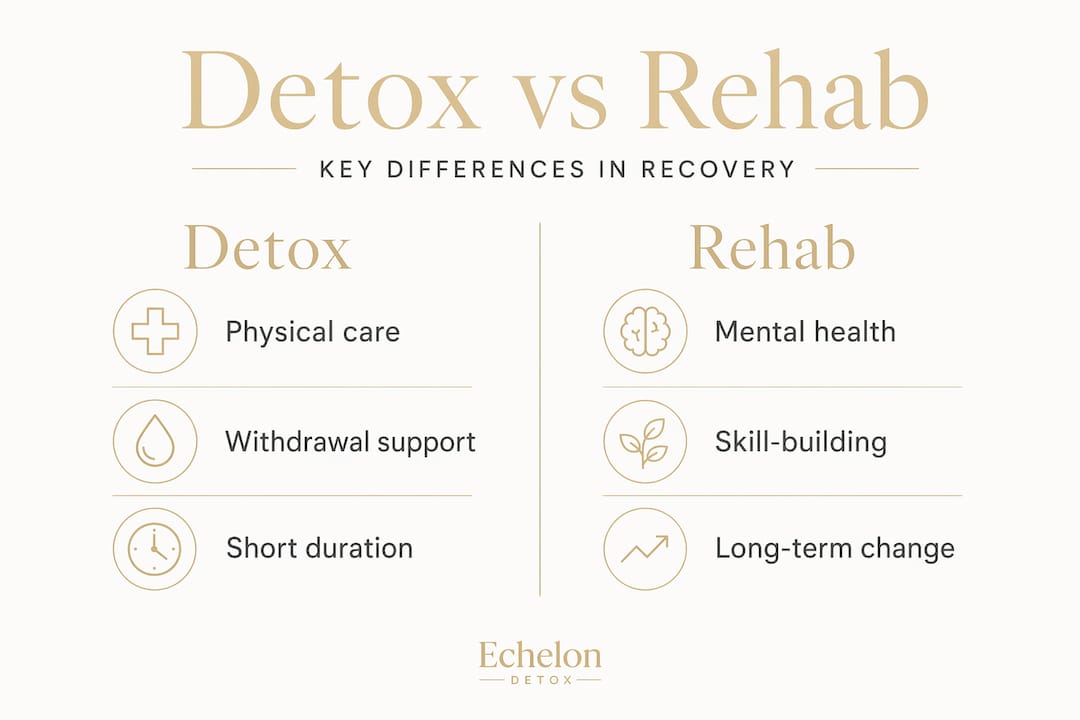
Detox handles the physical side: the body's physiological dependence on a substance. Rehab handles everything else. That includes the psychological patterns driving use, the behavioral responses to stress and trauma, the social circumstances that sustain the cycle, and the neurological recovery that takes months beyond initial sobriety. As one clinical resource puts it, detox stabilizes the body while rehab strengthens the mind. They are parts of a continuum, not competing alternatives.

| Dimension | Detox | Rehab |
|---|---|---|
| Primary focus | Physical stabilization and withdrawal management | Psychological, behavioral, and social recovery |
| Duration | Typically 5 to 10 days | 30 to 90 days or longer depending on need |
| Core tools | Medical supervision, medications, monitoring | Therapy, counseling, peer support, skill building |
| What it resolves | Physical dependence on the substance | Addiction triggers, coping deficits, mental health |
| Outcome alone | Body cleared of substance; addiction persists | Requires detox completion to begin effectively |
The most sobering evidence on this point: people who complete detox but do not enter rehab face a 90% relapse rate. That number reflects not a failure of willpower but a failure of treatment. The neurobehavioral circuits that drive addiction, the deeply ingrained response patterns in the brain, remain completely intact after detox. Without structured therapy and support, those circuits resume control.
There is also a specific vulnerability during what clinicians sometimes call the "detox gap." When someone completes detox but has no immediate placement in a rehab program, they return to their environment. They encounter familiar people, places, and emotional states linked directly to relapse risk. Their body is no longer physically dependent, but their psychological relationship with the substance is unchanged. That combination is genuinely dangerous.
Transitioning from detox to rehab seamlessly
Detox is not the destination. It is, as the clinical consensus describes it, the starting line for treatment. And what happens immediately after detox has as much impact on long-term recovery as detox itself.
The period immediately following detox carries a specific emotional challenge that many patients do not anticipate. Neurochemically, early withdrawal disrupts the brain's ability to experience pleasure. Stress hormones remain elevated, and the reward system that was hijacked by substance use does not reset overnight. This state, known clinically as anhedonia, means patients feel flat, unmotivated, and emotionally vulnerable precisely when they are expected to engage with intensive therapy. Immediate transition into residential treatment eliminates the dangerous period when this emotional state intersects with access to substances.
Structured residential programs that begin directly after detox provide several critical benefits:
- Continuity of clinical care: Physicians and counselors who know your medical history from detox can tailor the early rehab experience to your specific withdrawal profile.
- Protected environment: Being in a structured setting removes access to substances and reduces exposure to the triggers that drive relapse during the anhedonia window.
- Therapeutic momentum: Starting therapy while the motivation that prompted you to seek help is still fresh produces better engagement than returning weeks later.
- Medical follow-up: Some withdrawal symptoms, particularly for benzodiazepines, extend well beyond the initial detox window and require ongoing clinical management.
Pro Tip: Before you begin detox, ask your clinical team to outline your full care continuum, including which rehab program follows detox. Having that plan confirmed in advance eliminates the gap that causes most post-detox relapses.
Planning your full care continuum early is one of the most protective decisions you can make. The role of your physician in detox includes facilitating that transition, not just managing the withdrawal phase.
Psychological benefits of rehab following detox
Once the body is stable, rehab addresses the layer of addiction that detox cannot reach. The psychological benefits of rehabilitation following detox are not supplemental to recovery. They are central to it.
Addiction does not develop in a vacuum. Most people who develop a dependence on alcohol or drugs are also navigating unresolved trauma, anxiety, depression, or chronic stress that predates their substance use. Detox clears the substance. It does not resolve what drove someone toward it.
Rehab therapies like Cognitive Behavioral Therapy (CBT) and trauma recovery work directly on the psychological triggers that detox never touches. CBT helps patients identify and interrupt the thought patterns that lead to use. Motivational enhancement therapy strengthens internal commitment to sobriety. Trauma-focused approaches process the experiences that created vulnerability to addiction in the first place.
Beyond individual therapy, rehab also provides:
- Relapse prevention planning: Patients learn to identify their personal high-risk situations and practice concrete responses before leaving the structured environment.
- Community and peer support: Connection with others at similar stages of recovery reduces shame, builds accountability, and offers real-world evidence that sustained sobriety is possible.
- Skill development: Social skills, stress management techniques, and healthy routines replace the coping patterns organized around substance use.
- Brain recovery support: Rehab provides the structured time and emotional scaffolding that the brain needs to restore healthier reward and stress-response patterns.
How detox aids recovery is not just physical. The calm, clear state that a successful detox produces creates the neurological opening that rehab then works to develop and sustain.
Choosing a safe detox and rehab program
Not all detox programs offer the same standard of care. Knowing what to look for protects you during the most physically vulnerable phase of the recovery process.
A medically sound detox program requires, at minimum, licensed physicians and nursing staff available around the clock. This is not optional for substances like alcohol and benzodiazepines where seizure risk is real. Clinical density and emergency readiness distinguish a safe detox environment from an understaffed one where complications can go unaddressed.
When evaluating any detox program, ask directly about:
- Physician-led oversight: Is a licensed physician available 24 hours a day, or only on call?
- Medication protocols: Does the program use evidence-based medications for withdrawal management, or is it purely observational?
- Emergency response capacity: What is the specific protocol if a patient experiences a seizure or cardiac event?
- Transition planning: Does the program actively coordinate rehab placement, or does that responsibility fall entirely on the patient?
- Individualized care: Is your treatment plan built around your specific health history, substances used, and timeline, or is it one-size-fits-all?
A quality program answers all of these questions with specificity and confidence. Vague or dismissive responses should prompt you to look elsewhere. The risks of unsafe detox environments are well documented, and your safety depends on choosing a provider with the clinical infrastructure to match its promises.
My perspective on why this step cannot be skipped
I have seen what happens when someone powers through detox on their own and believes that is enough. They feel physically better for a few days, sometimes a week. Then the emotional weight they numbed with substances returns at full force, and they have no tools to carry it. The relapse is almost never about lack of desire to stay sober. It is about stepping into a raw emotional state with no support structure and no skills.
In my experience, the patients who struggle most in long-term recovery are not the ones who had the hardest detox. They are the ones who left too soon after detox, or who treated detox as the whole treatment rather than the beginning of it. That distinction is not semantic. It is the difference between clearing a path and actually walking it.
Detox and rehab are not two options you choose between. They are two phases of one process, and coordinated transition improves outcomes in ways that neither phase can achieve alone. If you are considering recovery, do not let anyone convince you that getting through withdrawal is the whole job. It is the first part of a larger, genuinely life-changing commitment.
— Nichol
How Echelondetox supports your safe detox and recovery

Echelondetox provides physician-led, in-home medical detox designed to keep you safe, comfortable, and clinically supported from the first hour of withdrawal. Every care plan is built around your specific health history, the substances involved, and your personal recovery timeline.
What sets Echelondetox apart is not just the quality of medical oversight during detox. It is the active coordination that follows. Echelondetox works directly to close the gap between detox completion and structured rehab placement, because that transition window is where outcomes are decided.
If you are ready to begin your recovery with the level of care, privacy, and medical attention you deserve, explore Echelondetox's services and connect with a team that understands both the clinical and human dimensions of this step.
FAQ
Why is detox necessary before starting rehab?
Detox clears the physical dependence on a substance so the body is medically stable enough to engage with therapy. Without it, withdrawal symptoms and cognitive impairment make meaningful participation in rehabilitation nearly impossible.
What happens if you skip detox and go straight to rehab?
Attempting rehab without prior detox puts you at risk for acute withdrawal during the therapeutic process, which can be both dangerous and counterproductive. Most licensed rehab facilities require medical detox clearance before admission.
How long does the detox process before treatment take?
Medical detox typically lasts 5 to 10 days, though duration varies based on the substance, duration of use, and individual health factors.
What is the relapse risk after detox without rehab?
Without entering a structured rehab program after detox, the relapse rate is approximately 90%. Detox alone does not address the behavioral and psychological dimensions of addiction.
What should I look for in a safe medical detox program?
Look for 24/7 licensed physician oversight, evidence-based medication protocols, emergency response capacity, individualized care planning, and active coordination with a rehab program for seamless transition after detox is complete.