

Home detox is defined as medically supervised substance withdrawal conducted in a patient's own residence, combining physician oversight with the privacy and comfort of a familiar environment. For high-income Texans, this model resolves a conflict that inpatient facilities cannot: the need for genuine clinical safety alongside absolute discretion. Executives, attorneys, physicians, and business owners across Texas are choosing this approach, formally called ambulatory medical detoxification, because it protects both their health and their professional standing. The reasons why high income Texans prefer home detox come down to three factors: privacy, personalized detox programs, and the ability to maintain life without interruption.
Why high-income Texans prefer home detox over inpatient care
The most direct answer is that inpatient disruption blocks treatment engagement for many professionals. Checking into a residential facility means absences that colleagues notice, schedules that collapse, and a paper trail that can follow a person for years. For a Dallas energy executive or an Austin tech founder, that exposure is not a minor inconvenience. It is a genuine deterrent to seeking help at all.
Home detox removes that barrier without removing clinical rigor. At-home detox offers privacy, personalized care plans, and flexible scheduling that are the primary drivers of patient satisfaction in this model. A licensed physician and trained nursing staff come to you. Medications are administered and monitored on-site. Withdrawal is managed with the same evidence-based protocols used in a hospital setting, just delivered in your home.

This matters because medical detox at home is a legitimate clinical pathway, not a lesser form of treatment. The model combines physician oversight and trained companions to meet the same clinical standards as facility-based care. For high-income Texans who have spent their careers demanding excellence in every service they use, that standard is non-negotiable.
What clinical factors determine if home detox is appropriate?
Not every person is a candidate for ambulatory medical detoxification, and understanding why matters before you pursue this path. The American Society of Addiction Medicine (ASAM) Criteria provide the clinical framework physicians use to assign the correct level of care. Two dimensions are most relevant here.
Dimension 1 evaluates withdrawal severity and the risk of acute complications. Dimension 6 assesses the recovery environment, including whether the home setting is stable, supportive, and free of substances. Both dimensions must support home-based care before a physician can responsibly recommend it.
Patients who are not appropriate candidates for home detox include:
- Those with a history of severe alcohol withdrawal, including seizures or delirium tremens
- Individuals with benzodiazepine dependency at high doses
- Polysubstance users with complex, unpredictable withdrawal profiles
- Patients with unstable cardiovascular, hepatic, or neurological conditions
Patients with severe withdrawal risk require Level 3.7 or 4.0 care for safety, meaning medically managed intensive inpatient treatment. That is not a failure of the home detox model. It is the model working correctly by directing each patient to the right level of care.
For candidates who do qualify, clinicians must assess severity and environment, documenting their rationale according to ASAM and payer requirements. This documentation also supports insurance authorization when applicable. A thorough ASAM Dimension 6 environmental assessment directly impacts whether home detox is approved and funded.
Pro Tip: Before scheduling any home detox program, request a formal ASAM-based clinical assessment from a licensed physician. This protects you medically and creates the documentation needed for insurance reimbursement.
How does home detox compare to inpatient detox?
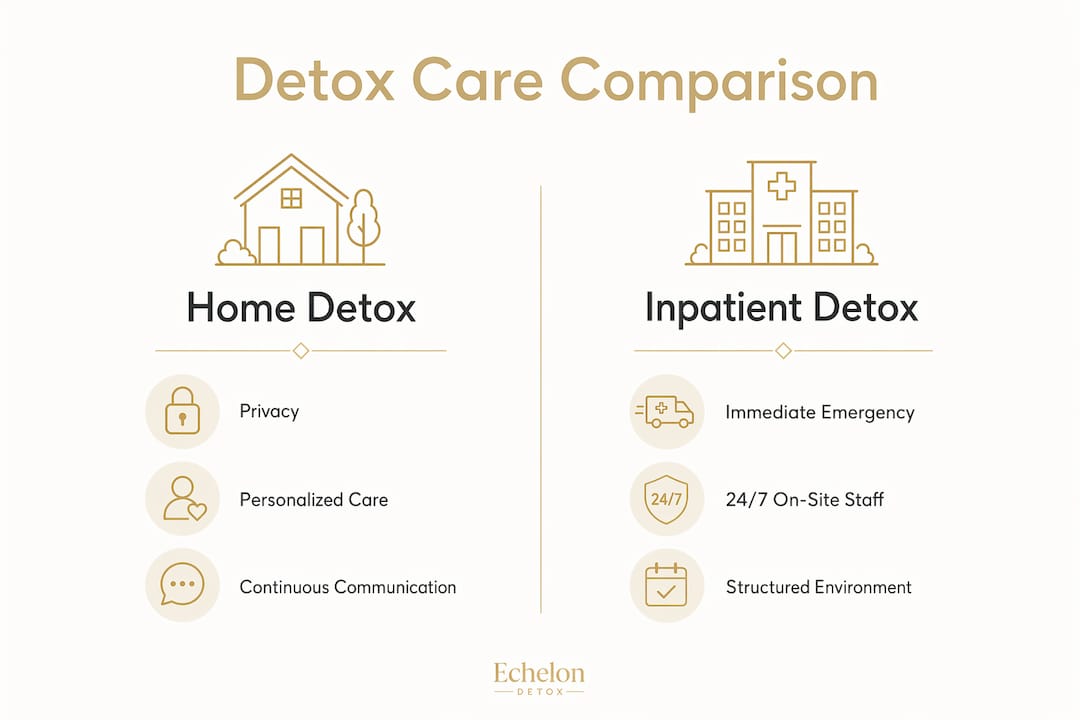
The comparison between home detox and inpatient detox is not simply about comfort. It involves real differences in privacy exposure, lifestyle impact, and cost structure. The table below maps the key factors.
| Factor | Home detox | Inpatient detox |
|---|---|---|
| Medical monitoring | 24/7 physician and nurse on-site | 24/7 facility staff, shared attention |
| Privacy | Complete. No public record of admission | Facility admission creates a documented record |
| Lifestyle disruption | Minimal. You remain in your home | Significant. Requires full absence from work and family |
| Personalization | Fully customized protocols | Standardized programs with limited flexibility |
| Cost | Premium, often comparable to inpatient | High, with variable insurance coverage |
| Emergency access | Physician-directed transfer if needed | Immediate on-site emergency response |
The privacy column is where high-income Texans make their decision. Patients report comfort, dignity, and ongoing communication as critical advantages during withdrawal. Dignity is not a luxury add-on. For someone managing a public profile or a professional license, it is a clinical necessity that affects whether they seek treatment at all.
The one area where inpatient care holds a genuine advantage is emergency response time. If a medical complication arises, a hospital-based facility can respond faster than a home team can arrange a transfer. This is exactly why physician-led home detox programs include clear escalation protocols and why candidacy screening is so important. The in-home detox safety guide published by Echelondetox covers these protocols in detail for anyone weighing the decision.
Pro Tip: Ask any home detox provider to walk you through their emergency escalation protocol before you commit. A credible program has a documented transfer plan and relationships with local emergency services.
What personalized features do home detox programs offer?
Personalization is the defining feature of home detox for affluent clients, and it operates at every level of care. This is where the model genuinely separates itself from standardized facility programs.
Customization begins with the withdrawal timeline and medication protocol. A physician reviews your full medical history, current substance use, prior withdrawal experiences, and any co-occurring conditions before designing your detox plan. No two plans are identical because no two patients are identical.
The features that high-income Texans consistently value most include:
- Scheduling flexibility. Detox can begin on your timeline, not a facility's intake calendar. For a professional managing board meetings or client obligations, this matters.
- Dedicated medical team. You work with the same physician and nursing staff throughout your detox, not rotating shift workers who read your chart for the first time each morning.
- 24/7 availability. Withdrawal symptoms do not follow business hours. A qualified home detox program provides around-the-clock access to your medical team.
- Discreet staffing. Medical personnel arrive without marked vehicles or uniforms that signal their purpose to neighbors or household staff.
- Wellness integration. Programs can incorporate nutritional support, sleep protocols, and comfort medications that a standard facility formulary would not include.
The practical steps for building a personalized program follow a clear sequence:
- Complete a comprehensive health intake covering substance history, medical conditions, and current medications.
- Undergo a formal withdrawal risk assessment using validated tools such as the CIWA-Ar for alcohol or COWS for opioids.
- Confirm that your home environment meets the stability criteria required for safe ambulatory detox.
- Establish a dedicated point of contact within your medical team for the duration of your program.
- Agree on a written escalation plan that defines the conditions under which inpatient transfer would be initiated.
Strong home support systems are key to at-home detox success, and this is one area where professional companions add real value. Many high-income clients prefer to involve a trained companion rather than a family member, preserving both privacy and family relationships during a vulnerable period. The concierge detox model is specifically designed to accommodate this preference.
What practical steps ensure a safe and successful home detox?
Safety in home detox is not passive. It requires deliberate preparation before the first day of withdrawal begins.
The first step is selecting a physician with documented experience in ambulatory detoxification, not simply a general practitioner willing to supervise. Withdrawal management is a specialized clinical skill. The physician should be able to discuss ASAM Criteria fluently, explain their medication protocols for your specific substance, and describe their monitoring schedule in concrete terms.
The second step is a thorough home environment assessment. Physicians recommend in-home detox only when patients have stable health and conducive home settings. This means removing access to substances, identifying a quiet and comfortable recovery space, and confirming that at least one trusted person will be present or reachable throughout the process.
The third step is continuous communication with your medical team. Withdrawal symptoms can shift quickly, and your team needs real-time information to adjust medications and monitoring frequency. Many programs use structured check-in schedules combined with on-call access for urgent concerns.
Pro Tip: Prepare a written summary of your full medication list, including supplements and over-the-counter medications, before your first physician consultation. Drug interactions during withdrawal can be serious, and complete information protects you.
The fourth step is planning for the days immediately following detox. Withdrawal management is the beginning of recovery, not the end. Connecting with outpatient therapy, a psychiatrist, or a recovery support program before detox begins means you have a clear next step when the acute phase ends. The stigma reduction benefits of home-based care extend into this transition, making it easier to continue treatment without the social exposure that deters many high-income individuals from staying engaged.
Key takeaways
High-income Texans choose home detox because it delivers physician-supervised withdrawal with complete privacy, personalized protocols, and zero disruption to professional life.
| Point | Details |
|---|---|
| Clinical candidacy matters | ASAM Criteria determine suitability; severe withdrawal cases require inpatient care regardless of preference. |
| Privacy drives the decision | Home detox creates no facility admission record, protecting professional and public reputations. |
| Personalization is the standard | Dedicated physicians, custom medication protocols, and flexible scheduling define quality home detox programs. |
| Home environment is a clinical factor | A stable, substance-free home setting is a medical requirement, not just a comfort preference. |
| Preparation determines outcomes | Physician selection, environment assessment, and post-detox planning are all required before day one. |
What I have seen working with high-income clients in Texas
The pattern I observe most consistently is this: the people who need help the most are often the ones with the most to lose by asking for it publicly. A managing partner at a law firm, a surgeon, a state legislator. These are not people who can walk into a residential facility and disappear for two weeks without consequences they cannot control.
What home detox does for this population is not just provide comfort. It removes the single biggest obstacle to treatment initiation: the fear of exposure. When that fear is gone, people actually start. And starting is everything.
I do want to be direct about one thing. Home detox is not the right answer for everyone, and any provider who tells you otherwise is not being honest with you. Severe alcohol withdrawal can be fatal without the right level of medical intervention. The clinical screening process exists to protect you, not to sell you a service. A program that skips that step is one you should walk away from.
What I respect about the best home detox programs is that they hold that line. They turn away clients who need a higher level of care and refer them appropriately. That clinical integrity is what makes the model trustworthy for the clients who are genuinely appropriate candidates.
— Nichol
How Echelondetox supports personalized home detox for Texans
Echelondetox is a physician-guided concierge detox service built specifically for individuals who need medically supervised withdrawal without the exposure of a residential facility.

Every program begins with a formal clinical assessment, followed by a fully customized detox plan designed around your health history, substance use, and schedule. Licensed physicians and nurses provide 24/7 in-home care with complete discretion. No marked vehicles. No facility records. No compromise on clinical standards. If you are ready to explore whether home detox is the right path for you, Echelon Detox offers confidential consultations with experienced physicians who understand both the medical and personal dimensions of this decision.
FAQ
What is ambulatory medical detoxification?
Ambulatory medical detoxification is the clinical term for medically supervised withdrawal conducted outside a hospital or residential facility, typically in a patient's home. It uses the same evidence-based protocols as inpatient detox, delivered by licensed physicians and nurses on-site.
Who is not a candidate for home detox?
Patients with a history of severe alcohol withdrawal, high-dose benzodiazepine dependence, or complex polysubstance use are not appropriate candidates for home detox. ASAM Criteria specify these individuals require Level 3.7 or 4.0 inpatient medical management for safety.
How private is home detox compared to inpatient treatment?
Home detox creates no facility admission record and involves no public-facing intake process. Medical staff arrive discreetly, and all care is documented privately between you and your physician.
Does home detox work for opioid withdrawal?
Yes, for appropriate candidates. SAMHSA allows take-home opioid treatment under documented clinical criteria, and evidence shows this approach reduces overdose mortality and improves treatment engagement when provider judgment is applied carefully.
How do I know if my home environment qualifies for home detox?
A qualified physician will assess your home setting as part of the ASAM Dimension 6 evaluation, confirming that it is stable, substance-free, and supported by at least one responsible person present during the withdrawal period.