

Addiction stigma is not a minor discomfort. It is one of the primary reasons people delay or avoid treatment entirely. Many individuals assume that seeking help means checking into a facility, taking a visible leave of absence, and accepting the social consequences that follow. That assumption stops real people from getting real care. Understanding why in-home detox reduces stigma means understanding how privacy, autonomy, and dignity can transform the entire recovery experience. This article covers the evidence behind stigma's impact, how in-home addiction treatment directly addresses that harm, and what it looks like to recover safely, discreetly, and on your own terms.
Table of Contents
- Key takeaways
- How stigma shapes addiction treatment decisions
- Why in-home detox reduces stigma more than facility-based care
- Comparing stigma across detox settings
- Medical safety and privacy working together
- How stigma reduction connects to long-term recovery
- My perspective on stigma and in-home detox
- Echelondetox: private, medically supervised home detox
- FAQ
Key takeaways
| Point | Details |
|---|---|
| Stigma blocks treatment | Perceived stigma measurably lowers the odds of completing addiction treatment, often before it begins. |
| Privacy protects identity | In-home detox preserves professional and personal roles by keeping recovery out of public view. |
| Medical safety is maintained | Licensed physicians and telehealth check-ins provide clinical oversight without requiring facility admission. |
| Home settings reduce shame | Familiar surroundings lower stress and support emotional stability during detox. |
| Low-threshold models work | Accessible, discreet care models engage individuals who would otherwise avoid treatment altogether. |
How stigma shapes addiction treatment decisions
Stigma around addiction operates on two levels, and both cause serious harm. Social stigma is the external judgment from employers, family members, neighbors, and the broader community. Internalized stigma is the shame a person absorbs from those external messages, the voice that says you brought this on yourself or you don't deserve help. Together, they create a barrier that is often more powerful than the addiction itself.
The consequences are measurable. Research shows that each one-unit increase on the Perceived Stigma of Addiction Scale associates with a 3% decrease in treatment completion odds, across a study of 7,591 participants. That may sound modest in isolation, but compound it across a multi-week detox and ongoing recovery program, and the effect becomes clinically significant.
Stigma also contributes to social isolation, mental health deterioration, and a deepened reluctance to seek care at all. When people fear that asking for help will cost them their job, their reputation, or their relationships, many simply choose to manage alone. That choice carries its own serious risks.
Here is what stigma actually does to treatment access and outcomes:
- It delays treatment initiation, sometimes by years
- It increases the likelihood of relapse after incomplete detox
- It amplifies shame, which worsens depression and anxiety
- It discourages honest communication with healthcare providers
- It creates a cycle in which untreated addiction reinforces the stigma that blocked treatment in the first place
Reducing stigma in recovery is not just a social good. It is a clinical imperative. Provider training programs that reduced stigma in care settings showed that 98% of rank comparisons demonstrated increased provider willingness to prescribe supportive medications after just one hour of training. The stigma problem is real, but it responds to thoughtful intervention.
Why in-home detox reduces stigma more than facility-based care
The traditional model of detox puts recovery on display in ways most people do not realize. Checking into a residential facility requires an absence from work, explanations to family or household members, and in many cases, a visible disruption to your daily life. For executives, parents, healthcare workers, or anyone in a high-profile role, that visibility feels like an impossible cost.
In-home detox reframes the entire experience. Recovery happens in your own space, on a schedule that protects your existing roles and relationships. You do not have to tell your employer you are in treatment. You do not have to leave your household. You do not have to sit in a group setting with strangers during one of the most vulnerable periods of your life.
The home detox and stigma connection is direct: when treatment is invisible to the outside world, the fear of judgment loses its grip. In-home detox shifts the recovery narrative from institutional dependency to private, autonomous care that preserves identity. That shift matters enormously for treatment engagement.
Consider what home recovery stigma solutions actually protect:
- Professional identity: No gaps in your calendar that require explanation
- Parental and caregiver roles: You remain present and functional for your household
- Community standing: Your recovery remains your own private health matter
- Emotional safety: You detox surrounded by familiar comfort rather than clinical anonymity
- Medical privacy: Your records and treatment remain protected under strict confidentiality laws
Recovery in familiar surroundings also reduces physiological stress during detox. Stress is a documented relapse trigger. Removing the environmental stressors of an unfamiliar facility gives your body and mind better conditions for stabilizing.
Pro Tip: When researching in-home detox providers, ask specifically about their confidentiality protocols and whether their staff sign non-disclosure agreements. Your privacy rights deserve explicit confirmation before care begins. You can also review your legal protections through resources like this guide on detox confidentiality rights.

Comparing stigma across detox settings
Not all treatment settings carry equal stigma risk. The differences are practical and immediate.
| Setting | Visibility | Stigma risk | Disruption to daily life | Privacy level |
|---|---|---|---|---|
| Residential inpatient | High | High | Requires 30+ day absence | Low |
| Outpatient clinic | Moderate | Moderate | Requires regular visible appointments | Moderate |
| In-home detox | None | Low | Minimal to none | High |
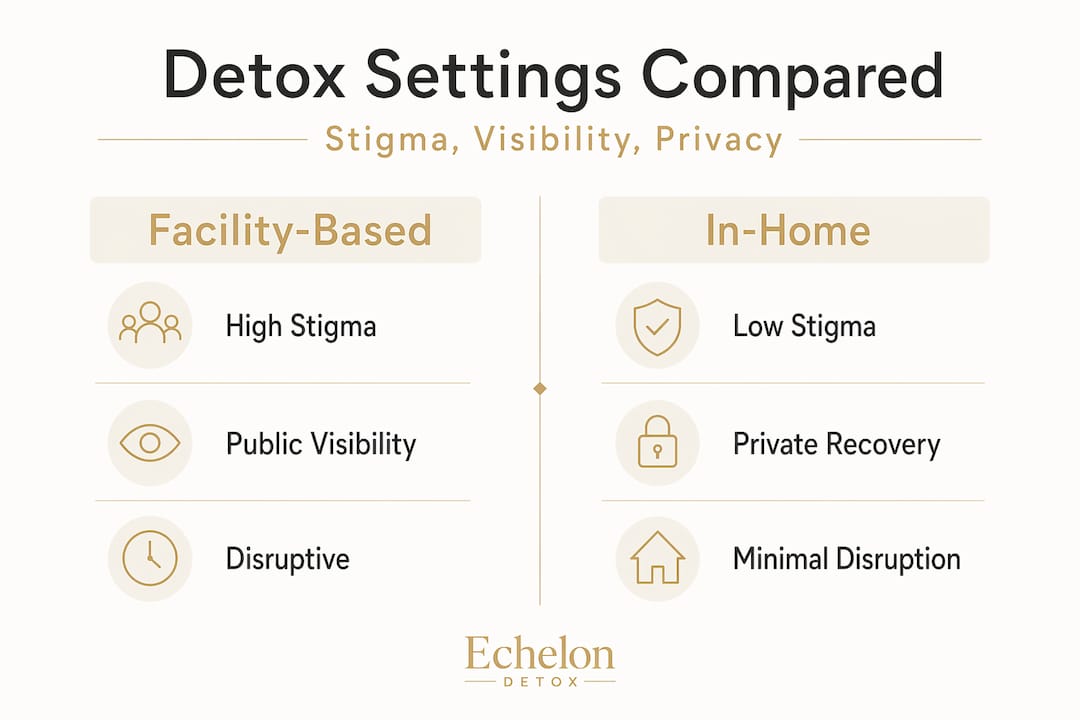
Residential care carries the highest stigma risk because it demands the longest absence and the most visible commitment. High-functioning individuals often avoid residential rehab specifically because a 30-day absence alerts employers and colleagues, threatening their professional identity. That avoidance does not mean they do not need help. It means the available options have not met them where they are.
Outpatient clinic settings reduce some of that burden, but regular appointments at a treatment facility can still draw unwanted attention. A coworker in the same medical building, a neighbor in the parking lot, a recurring morning absence. These are not paranoid concerns. They are realistic risks that people with careers and reputations weigh carefully.
In-home addiction treatment removes those risks entirely. The care comes to you. No building to enter, no facility to be seen at, no disruption that cannot be explained by ordinary life.
Home detox is particularly well-suited to:
- Working professionals and executives managing demanding schedules
- Parents and caregivers who cannot leave their household for extended periods
- Public figures and individuals in regulated industries where reputation carries legal weight
- People in smaller communities where facility visits would be immediately visible
The question of whether is home detox effective gets a clear answer from the evidence: with proper medical supervision, it produces outcomes comparable to inpatient care while significantly reducing the social and professional costs that prevent people from starting.
Medical safety and privacy working together
A legitimate concern about in-home detox is whether it is medically safe. The answer depends entirely on the quality of clinical oversight. Detox from alcohol and certain substances carries real physiological risks that require proper monitoring. Those risks do not disappear at home. They require the same clinical attention, simply delivered differently.
Here is what responsible in-home detox medical oversight looks like:
- Initial physician assessment: A licensed physician evaluates your health history, substance use patterns, and any contraindications before care begins.
- Customized detox protocol: Medications, dosing, and monitoring schedules are tailored to your specific physiology and withdrawal risk profile.
- On-site nursing care: A licensed nurse is present in your home during critical detox windows, not available by phone, actually present.
- Daily clinical evaluations: Vital signs, symptom progression, and medication response are assessed every day throughout the detox period.
- Telehealth physician check-ins: The supervising physician reviews your progress remotely and adjusts the plan in real time as needed.
Telehealth and daily evaluations provide clinical oversight without requiring public facility exposure. That combination of medical rigor and privacy is precisely what makes in-home detox a genuine alternative rather than a compromise.
Medical oversight in home settings also supports treatment adherence. When care feels safe and dignified rather than institutional and exposing, people are more willing to stay engaged through the full detox process.
Pro Tip: Before committing to any in-home detox provider, confirm that the supervising physician is licensed in your state and that your care plan includes clear escalation protocols for medical emergencies. Safe does not mean unsupervised. It means supervised where you are.
How stigma reduction connects to long-term recovery
Addressing home detox and stigma is not only about getting through the first week of withdrawal. The benefits of reduced stigma extend well into the recovery that follows.
When you complete detox without the social disruption of a visible facility stay, you return to your life with your identity intact. You were not labeled. You were not exposed. You made a private health decision and received excellent care for it. That psychological reality changes how you carry recovery forward.
Research on low-threshold treatment models shows they serve as a critical bridge to long-term recovery by engaging individuals who would never have entered traditional care. Home detox functions the same way. It meets people at the point where stigma would otherwise stop them.
The downstream effects of reduced stigma include:
- Higher rates of treatment completion because shame is not compounding the physical difficulty
- Greater willingness to pursue follow-on care, therapy, or support programs after detox
- Reduced anxiety and depression during recovery, which improves sustained motivation
- Stronger family relationships because care was handled with minimal disruption
- A foundation for viewing recovery as a health matter rather than a moral failure
Using person-first, respectful language in every part of care reinforces that the person is not their addiction. In-home detox, by its very structure, puts that principle into practice. The setting, the language, and the approach all communicate: you are a person making a courageous health decision, not a patient being managed.
My perspective on stigma and in-home detox
I have seen what stigma costs people in real terms. Not as an abstract social problem, but as the specific reason a senior attorney waited four years before asking for help. As the reason a mother told no one. As the reason a physician managed withdrawal alone rather than risk anything that might show up somewhere.
In my experience, the fear of being seen in treatment is often more paralyzing than the fear of detox itself. Traditional care structures have not fully reckoned with that. They offer clinical excellence in settings that carry unavoidable social exposure. For many people, that trade-off is simply unacceptable.
What I have learned is that in-home detox does not just make treatment more comfortable. It makes treatment possible for a significant group of people who would otherwise go without. That is not a minor distinction. That is the clinical and human case for this model.
The challenges that remain are real. Broader stigma reduction requires cultural shifts that no single treatment setting can accomplish alone. But for the person standing at the edge of a decision right now, in-home detox offers something concrete and immediate: the ability to heal without forfeiting your privacy, your identity, or your place in your own life.
If you are considering your options, my honest encouragement is to take discreet, medically supervised care seriously. It is not a lesser form of treatment. For many, it is the better one.
— Nichol
Echelondetox: private, medically supervised home detox

Echelondetox provides physician-guided, concierge detox care delivered entirely in the privacy of your home. If what you have read resonates with your situation, the next step is straightforward. Licensed physicians and nurses come to you, build a care plan around your specific health history and lifestyle, and stay with you through the full detox process. No facility admission. No explanations owed to anyone. No compromise on clinical quality.
Echelondetox serves clients nationwide, with particular experience supporting professionals, executives, caregivers, and public figures who require absolute discretion. You can explore in-home detox services or connect with a care coordinator to discuss your situation confidentially. Healing begins where you are most yourself.
FAQ
What makes in-home detox better for reducing stigma?
In-home detox keeps recovery entirely private, removing the visible facility admission that often triggers social judgment. Because there is no public exposure, the fear of professional or social consequences no longer becomes a barrier to seeking care.
Is home detox medically safe?
Yes, when delivered by licensed physicians and nurses with daily monitoring and clear emergency protocols. Medical supervision in home settings provides the same clinical oversight as inpatient care without requiring facility admission.
Who is in-home detox most appropriate for?
In-home detox is particularly well-suited to working professionals, executives, caregivers, and anyone whose career or personal life makes a visible facility stay impractical or unsafe from a privacy standpoint.
How does stigma affect treatment completion?
Research shows that higher perceived stigma reduces treatment completion odds by approximately 3% per unit increase on the Perceived Stigma of Addiction Scale, meaning stigma measurably shortens how long people stay in care.
Can in-home detox support long-term recovery, not just the initial withdrawal?
Yes. By preserving your identity and reducing shame throughout detox, in-home addiction treatment improves the psychological foundation for sustained recovery. People who complete detox with their dignity intact are more willing to continue with follow-on care and support programs.