

Touring musicians live by a relentless calendar. Show dates, travel legs, soundchecks, and media obligations leave almost no room for personal downtime, let alone a multi-week stay at a residential treatment facility. That reality is exactly why in-home detox suits touring schedules so well. When the window between two tour dates runs only a few days, or when privacy is non-negotiable for someone who performs publicly, a rigid inpatient program is simply not a realistic path. Flexible, physician-guided detox at home changes the equation entirely, and more touring professionals are taking notice.
Table of Contents
- Key takeaways
- Unique challenges of detox during touring schedules
- How in-home detox fits a musician's lifestyle
- Medical safety and clinical support for touring professionals
- Practical tips for detox between tour dates at home
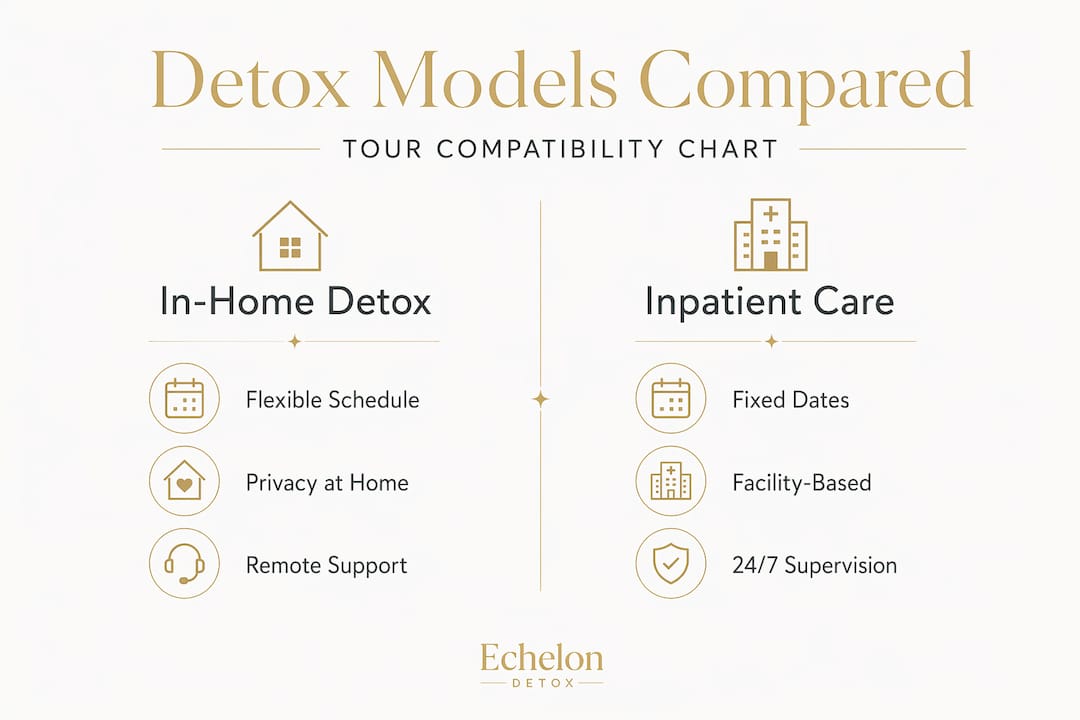
- Comparing detox models for touring compatibility
- My perspective on in-home detox for touring musicians
- Discreet, flexible detox care built for your schedule
- FAQ
Key takeaways
| Point | Details |
|---|---|
| Touring creates unique detox barriers | Unpredictable schedules, shared accommodations, and performance demands make standard programs impractical for most musicians. |
| In-home detox offers real flexibility | Care can be scheduled around gig dates, travel legs, and personal obligations without pausing a career. |
| Medical oversight is non-negotiable | Safe home detox requires licensed physician monitoring, medication management, and clear emergency protocols. |
| Privacy supports recovery | Treating addiction discreetly reduces stigma and lowers stress, which directly benefits the withdrawal process. |
| Planning ahead protects your health | Coordinating detox between tour dates at home requires intentional scheduling with your management team and medical provider. |
Unique challenges of detox during touring schedules
Life on tour is physically and emotionally demanding in ways that rarely translate to people outside the industry. Understanding those demands is the first step in recognizing why conventional treatment models so often fail touring musicians.
Here are the core challenges that make standard detox programs a poor match for touring life:
- Unpredictable scheduling. Tour dates shift, venues change, and travel windows collapse with little warning. A Monday commitment can become a Sunday obligation overnight, making any fixed-schedule treatment program nearly impossible to maintain.
- Physical toll. Travel stress and inconsistent sleep compound withdrawal symptoms in ways that amplify discomfort and increase medical risk. A body already running on insufficient sleep and irregular meals is not the same body walking into a controlled clinical setting.
- Privacy in shared spaces. Tour buses, hotel rooms, and backstage areas are communal environments. Checking into an inpatient facility means telling your crew, your label, and potentially your audience that something is wrong. That exposure alone causes many musicians to delay getting help.
- Performance obligations. Canceling shows carries financial penalties, reputation damage, and team consequences that feel insurmountable to someone weighing whether to seek care.
- Emotional and psychological pressure. The psychological weight of maintaining a public persona while privately struggling with substance use is significant. Stress and anxiety are well-documented factors that intensify physical withdrawal symptoms, creating a feedback loop that makes recovery harder without proper support.
Each of these factors compounds the others. A musician who is sleep-deprived, stressed about an upcoming show, and sharing a bus with eight colleagues is not in a position to discreetly enter a 30-day residential program. The detox solution has to meet them where they actually are.
How in-home detox fits a musician's lifestyle
The flexibility of a well-designed in-home program is not just a convenience feature. It is a clinical advantage for people whose lives do not follow a predictable pattern. At-home treatment can provide access to medication-assisted treatment, therapy, and regular check-ins without requiring travel to a facility, which means care adapts to your schedule rather than forcing you to adapt to a facility's structure.
Here is how a thoughtfully designed in-home detox program accommodates touring life:
- Scheduling built around your calendar. Your physician works with your tour itinerary, not against it. Detox timing is set for windows between performances, with monitoring sessions arranged around travel and rehearsal demands.
- Discreet care in a chosen environment. Whether you are at home between legs or staying in a private rental during a break, the care team comes to you. There is no admission paperwork at a public facility and no risk of exposure.
- Telemedicine integration. When you are in transit or in a different time zone, virtual check-ins and remote monitoring keep clinical support consistent without requiring a fixed physical location.
- Personal support network involvement. Trusted managers, partners, or bandmates can be included in your care plan on your terms. Structured home care is designed to supplement your existing support rather than replace it.
- Reduced stigma. Discreet home detox keeps treatment private, which lowers the psychological barrier to starting care. Musicians wary of career consequences are far more likely to begin and complete a program when their privacy is protected.
Pro Tip: When selecting a home detox provider, ask explicitly how they handle telemedicine coverage across time zones and what their protocol is if you need to relocate mid-program. Those specifics reveal whether a program is genuinely built for touring professionals or simply marketed to them.
Being in a familiar or chosen environment during detox reduces anxiety and supports routine maintenance. For musicians, that comfort factor is not trivial. It is part of what makes recovery sustainable rather than something to white-knuckle through in a sterile clinical room.

Medical safety and clinical support for touring professionals
Flexibility should never come at the cost of safety. This is the most important distinction between a legitimate in-home detox program and an unsupported attempt to quit alone. Medical oversight is essential for managing withdrawal symptoms, medication protocols, and emergency preparedness, even when care happens outside a hospital.
The following table clarifies when in-home detox is appropriate and when a higher level of care is required:
| Factor | In-home detox appropriate | Inpatient care required |
|---|---|---|
| Addiction severity | Mild to moderate | Severe, long-term, or high-dose |
| Medical history | No major cardiac or seizure history | History of severe withdrawal or seizures |
| Support availability | Trusted person present or reachable | Isolated or unstable home environment |
| Prior withdrawal complications | None or minor | Prior delirium tremens or medically complex withdrawals |
| Co-occurring conditions | Stable, managed | Active psychiatric crisis or serious medical illness |
Residential centers provide 24-hour clinical monitoring necessary for severe addiction, while in-home detox suits those with manageable withdrawal risks and solid support. The criteria above are not a self-assessment checklist. They should be reviewed with a licensed physician who can evaluate your full health history before recommending a care level.
In practice, a physician-guided home program includes scheduled clinical check-ins, a clear medication management plan, and defined escalation protocols if symptoms become serious. For touring professionals dealing with time zone changes or intermittent connectivity, providers should have explicit protocols for remote monitoring and what to do if contact is temporarily disrupted.
Pro Tip: Before starting any home detox program on tour, make sure your designated support person has the emergency contact numbers for your care team stored in their phone. In a high-stress touring environment, having that layer of redundancy can matter enormously.
Practical tips for detox between tour dates at home
Planning matters as much as the program itself. Even the most medically sound detox plan will struggle if the surrounding logistics are not set up to support recovery. The good news is that with the right preparation, detox between tour dates at home is genuinely achievable.
- Communicate selectively with your team. You do not need to disclose the nature of your medical care to everyone. Work with your manager and booking agent to block out recovery days in your calendar as "personal health time." Most professionals will respect that framing without requiring details.
- Build in buffer days. Do not schedule detox to end the morning before a performance. Flexible detox plans work best when you have at least two to three recovery buffer days before returning to a demanding performance schedule.
- Prepare your physical environment. Whether you are at your home base or a private rental, set up your space with comfort in mind. Quiet, temperature control, easy access to food and hydration, and a low-stimulation atmosphere all support the process.
- Use telehealth proactively. Do not wait for symptoms to escalate before contacting your care team. Scheduled virtual check-ins, even brief ones, keep your physician informed and allow medication adjustments before small issues become serious ones.
- Invest in long-term accountability. Recovery does not end when detox does. Peer support groups, sober companions, and ongoing counseling adapted to your touring schedule are part of maintaining sobriety while continuing to perform. Treating addiction in the environment where habits formed builds stronger long-term coping skills than a facility-based program alone can provide.
Pro Tip: Talk to your medical provider about what substances or supplements are safe to have backstage and in your rider during and after detox. Eliminating surprise exposures is a simple but often overlooked piece of relapse prevention for touring professionals.
Comparing detox models for touring compatibility
Not every detox model fits every situation. Understanding the differences helps you and your physician make an informed decision about what level of care is right for your specific circumstances.
| Feature | Inpatient | Outpatient | In-home detox |
|---|---|---|---|
| Schedule flexibility | None | Moderate | High |
| Privacy level | Low to moderate | Moderate | Very high |
| Medical supervision intensity | 24/7 on-site | Scheduled visits | Continuous remote, with in-person as needed |
| Career disruption | Significant | Moderate | Minimal |
| Best suited for | Severe addiction | Mild cases with local access | Mild to moderate with touring or professional demands |
| Personalization level | Standardized | Moderate | Highly customized |
Outpatient programs offer scheduled counseling and therapy adapted around work demands, which makes them a reasonable option for some. But for touring musicians specifically, the requirement to appear at a fixed location on a fixed schedule still creates friction that home-based care eliminates. Structured programs that adapt to a patient's professional constraints consistently show better adherence and engagement than rigid models.
The table above is not a verdict. Inpatient care is the right choice when addiction severity requires it, full stop. But for musicians who fall into the mild to moderate category and who have access to a supportive environment and reliable physician oversight, home-based detox for professionals represents a genuinely clinically sound option, not a compromise.
My perspective on in-home detox for touring musicians
I have worked closely enough with touring professionals to know that the biggest obstacle to getting help is rarely willingness. It is logistics and fear of exposure. I have seen musicians who were genuinely ready to make a change walk away from the idea of treatment because the only model they knew required a month off the road and a public explanation to their entire team.
What I have learned is that the moment you present someone with a path that does not require them to blow up their career, the conversation changes completely. In-home detox removes the binary choice between getting sober and staying professional. That shift in framing is not just psychologically reassuring. It produces better outcomes because people actually start and complete the process instead of putting it off until a crisis forces the issue.
The pitfall I see most often is underestimating the need for real medical oversight. Home detox done with a licensed physician and a structured protocol is genuinely safe for the right candidates. Attempting to manage withdrawal without that support, even with the best intentions, is where things go wrong. Privacy and flexibility are real advantages. They work best when paired with clinical rigor, not used as a substitute for it.
If you are reading this and wondering whether the window between your next two tour dates is enough time to start, the honest answer is that it might be. But the only way to know is to have a real conversation with a physician who specializes in this work. Do not let uncertainty become the reason you wait another cycle.
— Nichol
Discreet, flexible detox care built for your schedule
For touring musicians and industry professionals who are ready to take the first step, Echelondetox offers physician-guided, fully private in-home detox designed around your life, not around a facility's calendar.

Every Echelondetox plan is customized to your health history, your schedule, and your personal privacy requirements. Licensed physicians and nurses come to you, whether you are at your home base between tour legs or staying in a private residence during a break. Care is available nationwide, and every detail of your treatment is handled with complete discretion. If you are ready to talk through what a program built around your touring schedule could look like, Echelondetox is ready to listen.
FAQ
Why does in-home detox suit touring schedules better than inpatient?
In-home detox allows care to be scheduled around performance dates and travel rather than requiring a fixed facility stay, which is impractical for touring professionals with unpredictable calendars.
Is home detox medically safe for musicians on tour?
Yes, for mild to moderate cases. Safe home detox requires licensed physician monitoring, medication management, and clear emergency protocols, all of which a qualified concierge provider delivers.
How much time between tour dates do I need for detox?
The required window depends on the substance, severity, and your health history. A physician assessment before your scheduled break will determine whether the available time is sufficient or whether a longer gap needs to be arranged.
Can I keep my treatment private from my label and management?
Yes. In-home detox at a private residence keeps your care entirely confidential. You control who knows, and a reputable provider will have strict privacy standards that protect your identity throughout treatment.
What happens if a medical issue arises while I am in a different city?
A well-designed touring schedule detox program includes telemedicine protocols and emergency escalation plans that account for travel and time zone variability. Confirm these specifics with your provider before beginning care.