

Alcohol withdrawal is not simply uncomfortable. It can be genuinely life-threatening, and that reality is consistently underestimated by people who are otherwise meticulous about managing risk. For executives and professionals who prefer privacy in every aspect of their lives, the instinct to handle detox quietly and independently is understandable. But alcohol withdrawal complications include seizures in 10 to 15% of cases and delirium tremens in 3 to 5%, both of which require immediate medical intervention. This article explains what actually happens during withdrawal, who faces the greatest danger, and why professional medical oversight is not optional for anyone who values both safety and dignity.
Table of Contents
- Understanding alcohol withdrawal: What actually happens in the body?
- The hidden risks: Complications that require medical oversight
- Who qualifies for home detox — and why few should go it alone
- How medical teams ensure safe, discreet, personalized detox at home
- The uncomfortable truth: Self-detox is a risk no leader should take
- Next steps: Secure private, medically supervised detox at home
- Frequently asked questions
Key Takeaways
| Point | Details |
|---|---|
| Withdrawal risks are real | Alcohol detox can cause dangerous complications regardless of prior health. |
| Medical supervision saves lives | Supervised detox dramatically reduces risk of seizures and delirium tremens. |
| Most people underestimate their risk | Even mild withdrawal can escalate quickly, especially with hidden health issues. |
| Professional care offers discretion | Medical teams ensure private, personalized detox for busy professionals at home. |
| Detox is just the start | Ongoing recovery planning is crucial for lasting change, not just initial safety. |
Understanding alcohol withdrawal: What actually happens in the body?
To understand why withdrawal is medically complex, you need to understand what alcohol does to the brain over time. Alcohol is a central nervous system (CNS) depressant. When you drink regularly and heavily, your brain adapts by reducing the activity of its natural calming signals and amplifying its excitatory ones. This is the brain's attempt to maintain equilibrium.
Specifically, chronic alcohol use enhances gamma-aminobutyric acid (GABA) inhibition and suppresses glutamate excitation. GABA is the brain's primary "slow down" neurotransmitter. Glutamate is the primary "speed up" signal. Over months and years of heavy drinking, the brain recalibrates around the presence of alcohol to compensate for these chemical shifts.
When alcohol is suddenly removed, the brain's suppressed glutamate system surges, and the dampened GABA system can no longer counterbalance it. The result is CNS hyperexcitability, a state where the brain and nervous system are firing at abnormally high levels. That hyperexcitability is the direct cause of the physical and neurological symptoms that define withdrawal.
Here is how those symptoms typically unfold:
- 6 to 12 hours after last drink: Anxiety, tremors (the "shakes"), sweating, elevated heart rate, and insomnia. These are the early warning signs.
- 12 to 24 hours: Hallucinations can begin, usually auditory or visual. These can be vivid and distressing but are not yet the most dangerous phase.
- 24 to 48 hours: Seizure risk peaks during this window. Grand mal seizures can occur without warning.
- 48 to 72 hours (and beyond): Delirium tremens may develop, marked by severe confusion, autonomic instability (rapid heart rate, high blood pressure, fever), and potentially fatal cardiovascular stress.
One of the most important clinical realities here is that the severity of withdrawal cannot always be predicted by how much a person drank recently. Factors like how many years someone has been drinking, previous withdrawal episodes, underlying health conditions, and genetic predisposition all influence the trajectory. A person who consumed what seems like a moderate amount may experience severe withdrawal. That unpredictability alone is a compelling reason to have a physician present.
The hidden risks: Complications that require medical oversight
With the science explained, let's look closer at the real dangers professionals face if they attempt withdrawal without the right support.
The statistics are stark. Alcohol withdrawal seizures and DTs affect a meaningful percentage of people who detox, and in an unsupervised setting, both can become fatal before emergency services even arrive. Delirium tremens specifically carries a mortality rate of up to 37% when untreated, though that figure drops dramatically to under 5% with proper medical management.

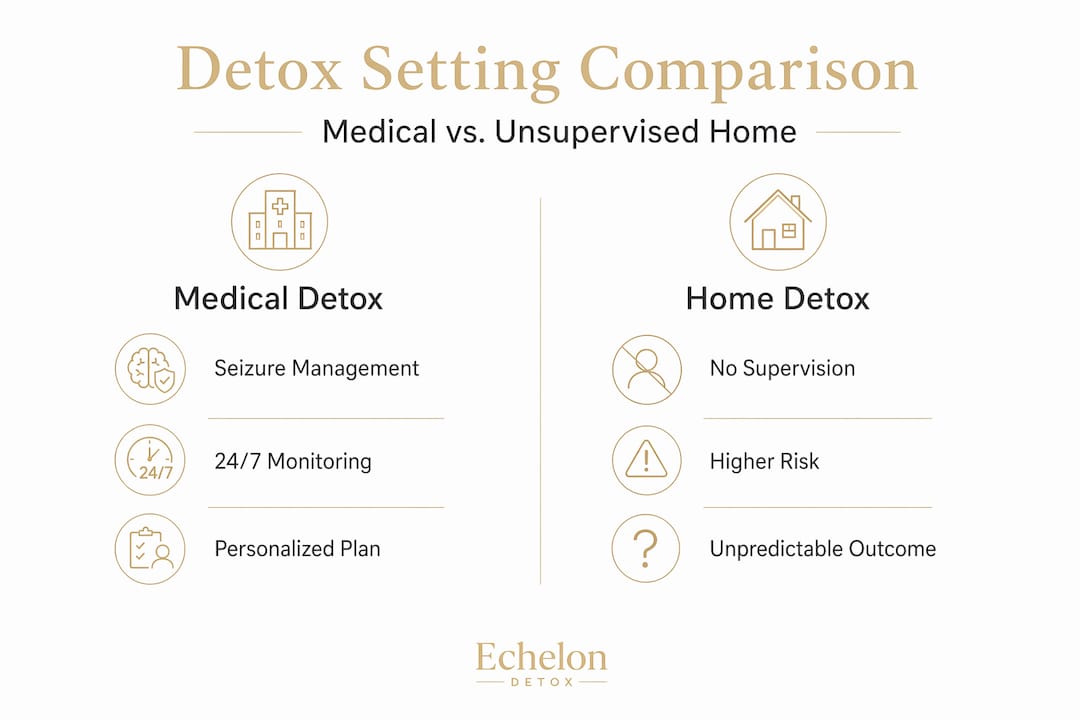
| Risk factor | Unsupervised home detox | Medically supervised detox |
|---|---|---|
| Seizure prevention | None | Benzodiazepines titrated to symptoms |
| Delirium tremens management | Delayed or absent | Immediate physician intervention |
| Vital sign monitoring | None | Continuous nursing assessment |
| Thiamine administration | Unlikely | Standard protocol |
| Privacy maintained | Partial | Full, by design |
| Outcome predictability | Low | High |
The table above reflects a fundamental truth: the gap between supervised and unsupervised detox is not a matter of comfort. It is a matter of survival outcomes.
Medical management of withdrawal follows evidence-based protocols. Benzodiazepines such as diazepam and lorazepam are the gold-standard medications for preventing seizures and delirium tremens. Thiamine (vitamin B1) is administered to prevent Wernicke-Korsakoff syndrome, a neurological condition that can cause permanent memory damage and is disproportionately common in people with long-term alcohol dependence. Vital signs are monitored continuously so that any escalation is caught early.
"The question is not whether you want help. The question is whether you want to give yourself the best possible chance of coming through this safely. Medical oversight answers that question."
Certain individuals carry substantially elevated risk and should never attempt withdrawal without physician supervision. These include people with a prior history of seizures or delirium tremens, individuals with liver disease, those with cardiovascular conditions, elderly individuals, and anyone using other substances alongside alcohol. For these groups, unsupervised detox is not just risky. It is genuinely dangerous.
Pro Tip: If you or someone close to you has experienced even one previous withdrawal seizure, that history predicts a higher likelihood of seizures in future withdrawals. Disclose this to your physician before any detox begins.
Who qualifies for home detox — and why few should go it alone
Understanding who truly qualifies for medically supervised home detox helps illustrate why supervised detox has become the standard of care, not the exception.
The clinical criteria for ambulatory or home-based detox are specific. According to guidance from clinical specialists, inpatient detox is indicated for people with moderate to severe withdrawal risk, including those with a history of DTs or seizures, significant comorbidities, or unstable living situations. Ambulatory or home-based detox may be appropriate only for carefully selected low-risk individuals, and even then, professional monitoring remains essential.
Here is how risk levels are typically assessed:
- Consumption history: Duration of heavy drinking, amount consumed daily, and frequency of prior withdrawal episodes.
- Medical comorbidities: Liver function, cardiovascular health, nutritional status, and any neurological history.
- Previous withdrawal pattern: If prior episodes were severe, current episodes are likely to be at least as severe.
- Social and environmental factors: Who is present in the home, access to emergency services, and the ability to monitor and respond to changes.
- Concurrent substance use: Combining alcohol withdrawal with sedative or opioid dependence dramatically increases risk.
Many executives make a specific error here: they underestimate their personal risk because they have functioned at a high level professionally. Functionality at work does not predict withdrawal severity. In fact, high-functioning individuals sometimes have longer-standing and heavier drinking histories precisely because their professional performance masked the extent of dependence for years.
At-home detox without professional oversight increases risk significantly, and even outpatient home-based programs are only appropriate for low-risk cases under consistent medical supervision. The distinction matters: home detox with a licensed physician and nursing team present is a clinically sound option for many. Home detox alone, with no medical presence, is not.
Pro Tip: A thorough intake assessment by a licensed physician is the only reliable way to determine your true withdrawal risk category. Self-assessment is not sufficient because people consistently underestimate the severity of their own dependence.
| Risk category | Withdrawal history | Appropriate setting |
|---|---|---|
| Low risk | None, mild prior withdrawal | Supervised home detox |
| Moderate risk | Some symptoms, no seizures | Supervised home or outpatient |
| High risk | Seizure, DT history, or comorbidities | Inpatient or intensive home care |
How medical teams ensure safe, discreet, personalized detox at home
Now that you know who needs supervision, here is what professional, private home detox actually looks like in practice.
For executives and professionals, the appeal of at-home detox is clear: no waiting rooms, no staff who recognize you, no public admission records. Properly structured medical home detox delivers all of that, while providing the clinical safeguards that a facility would. This is not a compromise. It is a genuinely excellent care model when executed correctly.
What a professionally managed home detox includes:
- Physician-led intake assessment: A licensed physician reviews your full health history, current medications, alcohol use timeline, and prior withdrawal experience before the first hour of detox begins.
- Customized medication protocol: Based on your clinical profile, medications such as benzodiazepines and thiamine are prescribed and administered precisely. There is no one-size-fits-all dosing.
- 24/7 nursing presence: Withdrawal evolves quickly. Having a licensed nurse in your home means that changes in vital signs, onset of hallucinations, or early seizure activity are caught and managed immediately rather than hours later.
- Nutritional support: Long-term alcohol dependence frequently causes nutritional deficiencies. A proper home detox addresses hydration, electrolytes, and targeted supplementation alongside medication.
- Mental health integration: Anxiety, depression, and emotional distress are common during withdrawal. A skilled medical team addresses these in real time rather than leaving you to manage them alone.
- Confidential records management: Every aspect of your care is handled with strict privacy. No shared databases, no facility records that surface on background checks.
- Transition planning: Safe detox is a starting point. A responsible medical team will help you begin the conversation about what comes next, whether that is outpatient therapy, psychiatric support, or another level of ongoing care.
The personalization element deserves emphasis. Two executives of similar age and drinking history may require very different medication protocols based on liver function, cardiovascular baseline, and anxiety levels. A medical team that treats you as an individual, not a case number, is what makes this approach both safe and sustainable.
The uncomfortable truth: Self-detox is a risk no leader should take
High-achievers are accustomed to controlling outcomes. You have built careers on the ability to manage complexity, assess risk, and execute under pressure. That same mindset, when applied to alcohol detox, can become genuinely dangerous.
The logic tends to go: "I understand my body. I can manage this privately. I've gotten through hard things before." And every part of that statement may be true in other contexts. But withdrawal physiology does not respond to willpower, discipline, or strategic thinking. The neurological processes underlying withdrawal are autonomous. They do not care how capable you are.
There is also a pattern we see consistently: the people who are most confident they can self-detox are often the ones who have been managing dependence the longest. The longer the history, the higher the neurological stakes during cessation.
Choosing clinical oversight is not a concession. It is the exact kind of informed, calculated decision-making that defines strong leadership. You assess the evidence, you recognize the limits of what you can manage alone, and you bring in expert support. That is not weakness. That is judgment.
It is also worth being direct about one more thing. Alcohol withdrawal management is the beginning of treatment for alcohol use disorder, not the end. Detox alone is insufficient for lasting recovery. ASAM and clinical guidelines are explicit that withdrawal management must integrate into a broader treatment approach to meaningfully reduce relapse risk. Completing detox safely is genuinely important. But the medical team you trust with your detox should also be helping you think clearly about what sustainable recovery looks like for your life.
The professionals who do this well are the ones who treat their recovery with the same seriousness and strategic care they bring to every other high-stakes decision.
Next steps: Secure private, medically supervised detox at home
If this article has clarified one thing, it should be this: safe alcohol detox requires medical expertise, and you deserve access to that expertise without sacrificing your privacy or your dignity. The right support does not require a public facility, a shared treatment floor, or any compromise to your professional standing.

At Echelon Detox, we provide executive at-home detox that combines 24/7 licensed physician and nursing care with absolute confidentiality and fully personalized medical protocols. Our clinical team conducts a thorough intake assessment, designs a withdrawal management plan built around your specific health profile, and stays with you through every stage of the process. You remain in your home, in your environment, with your privacy intact and your safety fully protected. Reaching out for a confidential consultation is not a commitment. It is simply the responsible first step toward reclaiming your health on your own terms.
Frequently asked questions
What are the first signs of dangerous alcohol withdrawal?
Early signs include tremors, sweating, anxiety, and insomnia, and severe withdrawal may progress quickly to seizures or delirium tremens within 24 to 72 hours of the last drink.
Is home detox ever completely safe without medical oversight?
Even mild withdrawal cases carry unpredictable risk; supervised home programs are appropriate only for carefully screened low-risk individuals, and professional monitoring remains essential even in those cases.
What medications are used during medical alcohol detox?
Physicians use benzodiazepines such as diazepam to prevent seizures and delirium tremens, along with thiamine to protect against serious brain complications linked to vitamin B1 deficiency.
How do I know if I qualify for medically supervised home detox?
Eligibility is determined by withdrawal severity and history, overall health profile, and comorbidities, all of which require a formal physician assessment rather than self-evaluation.