

The decision to pursue detox rarely feels simple, and for South Florida executives, it carries a distinct set of concerns that go beyond physical withdrawal. Understanding why South Florida executives seek home detox means looking honestly at the professional stakes, the social visibility, and the very real medical complexity that shapes every recovery decision. Inpatient facilities have their place. But for many high-functioning professionals in Miami, Boca Raton, and Fort Lauderdale, the idea of checking into a residential program raises immediate flags around reputation, confidentiality, and continuity. Home detox offers a medically sound, privacy-first alternative when managed correctly.
Table of Contents
- Key takeaways
- Why south florida executives seek home detox
- Medical safety: what withdrawal actually requires
- Privacy protections you likely do not know about
- How home detox serves executive-specific needs
- Home detox vs. inpatient vs. outpatient: choosing the right level of care
- How to evaluate and select a home detox provider
- My perspective on what actually drives executives to home detox
- Start your private, medically supervised home detox
- FAQ
Key takeaways
| Point | Details |
|---|---|
| Medical oversight is non-negotiable | Alcohol withdrawal can escalate to life-threatening delirium tremens without clinical supervision. |
| Federal law protects your privacy | 42 CFR Part 2 provides stricter confidentiality protections for substance use records than standard HIPAA. |
| Home detox fits executive schedules | Concierge-style home detox models accommodate professional obligations while delivering clinical-grade care. |
| Not all patients qualify for home detox | Clinical screening determines whether withdrawal risk is low enough to safely manage outside a hospital. |
| Post-detox planning is part of the process | Detox is medical stabilization only; a coordinated step-down care pathway supports lasting recovery. |
Why south florida executives seek home detox
The primary driver is not comfort. It is control. South Florida's executive class operates in an environment where perception matters at every level, from board relationships to client trust to community standing. A residential treatment admission, however private a facility claims to be, introduces exposure points: billing records, insurance claims, absences that require explanation, and the simple reality of being seen entering or leaving a known treatment center.
Boutique executive detox programs reduce stigma by combining clinical oversight with hospitality principles, creating environments where professionals can recover without surrendering their sense of identity or agency. That model resonates deeply with South Florida's executive wellness trends, where personalized, discreet healthcare is already the norm across concierge medicine, private therapy, and wellness retreats.
There is also a practical scheduling reality. Executives managing companies, investment portfolios, or legal practices cannot simply disappear for 30 days. Home detox allows clinical care to come to you, structured around your schedule, inside your own residence, with a team that understands both the medical and professional dimensions of the situation.

The South Florida wellness lifestyle has long embraced high-touch, individualized health services. Home detox fits naturally within that ethos. What separates responsible home detox from a dangerous self-managed taper is the clinical infrastructure behind it, and that distinction is the most important thing you can understand before making any decisions.
Medical safety: what withdrawal actually requires
This is where well-intentioned decisions can go fatally wrong. Alcohol withdrawal seizures create neurological hyperexcitability that progresses rapidly without benzodiazepines and proper supplementation, including thiamine and electrolyte correction. Many executives assume that self-tapering while continuing to work is a reasonable middle path. It is not. Risk escalates in ways that are not predictable from the outside, and unsupervised detox attempts carry serious clinical danger for this population.
Delirium tremens (DTs) is the most severe form of alcohol withdrawal. It typically begins 48 to 72 hours after the last drink and can involve seizures, severe confusion, cardiovascular instability, and respiratory failure. Untreated DTs mortality reaches 15% to 40%, while medically managed cases see survival rates of 95% to 99%. That gap is entirely attributable to clinical intervention.
Medically supervised home detox addresses this through structured protocols:
- Withdrawal risk assessment using validated clinical tools before any detox plan begins
- Medication management with benzodiazepines titrated to symptom severity to prevent seizures and cardiac complications
- Thiamine and electrolyte supplementation to reduce neurological risk
- Vital sign monitoring at scheduled intervals with clear criteria for emergency transfer
- 24/7 physician availability to adjust protocols based on real-time patient status
The clinical workflow for home detox always begins with determining whether the patient is an appropriate candidate. Moderate to severe alcohol use disorder, history of prior DTs or seizures, or significant co-occurring medical conditions typically require inpatient care. For patients who clear clinical screening, home detox with licensed physician oversight provides safety comparable to facility-based care.
Pro Tip: Ask any home detox provider directly: "What is your protocol if I deteriorate overnight?" If they cannot answer with specific steps, escalation criteria, and emergency transfer procedures, do not proceed with that provider.
Privacy protections you likely do not know about
Most executives know that medical records are protected. Fewer know that substance use disorder treatment records carry a separate, stricter layer of federal protection that sits on top of HIPAA. 42 CFR Part 2 restricts disclosure of any SUD-related records without the patient's written consent, with very limited exceptions such as medical emergencies or court orders.
Under Part 2, your detox records cannot be shared with an employer, a business partner, an insurer, or a family member without your explicit authorization. Records also cannot be used as evidence against you in legal proceedings without a specific court order. This protection applies regardless of whether your care happens in a facility or in your home.
What this means operationally in a home detox setting:
- Intake documentation is handled under restricted access protocols, limiting who in the clinical team sees identifying details
- Billing can be managed through direct-pay arrangements that avoid insurance disclosures entirely
- Communication channels are scripted and controlled, so no clinical team member inadvertently contacts a workplace number or sends documentation to an exposed email address
- Authorization forms specify exactly who may receive information and under what circumstances
Operational privacy in home detox requires the provider to have deliberate systems in place, not just an awareness of the law. When evaluating any program, ask to see their Part 2 compliance procedures and their policy on confidentiality rights and protections before you share any personal health information.
How home detox serves executive-specific needs
Healthy living for executives increasingly means care that meets them where they are, literally. Home detox benefits in South Florida extend beyond privacy into the structure and quality of the care itself.
The home environment removes several of the friction points that make traditional detox difficult for high-functioning individuals. You are not adjusting to an institutional setting, unfamiliar staff rotations, or shared facilities. You recover in a space where you already feel physically safe, with a clinical team assigned specifically to your case.
Consider what a well-structured home detox program actually delivers:
- Dedicated physician oversight with a single point of contact throughout the detox process
- Nurse presence during the acute withdrawal window, with shift coverage to ensure continuous monitoring
- Personalized medication protocols built around your specific history, prior withdrawal experiences, and current health status
- Flexible scheduling for clinical check-ins that do not require you to be physically absent from your responsibilities for weeks at a time
- Coordinated communication with your personal physician or psychiatrist when appropriate and with your written consent
Home detox services in Florida that are genuinely designed for executives also account for the social architecture of recovery. They recognize that discretion extends to every interaction, from how the clinical team arrives at your residence to how they communicate with you going forward. Executive stress relief during detox is not about luxury amenities. It is about eliminating the distractions and exposures that would otherwise derail the process.
Home detox vs. inpatient vs. outpatient: choosing the right level of care
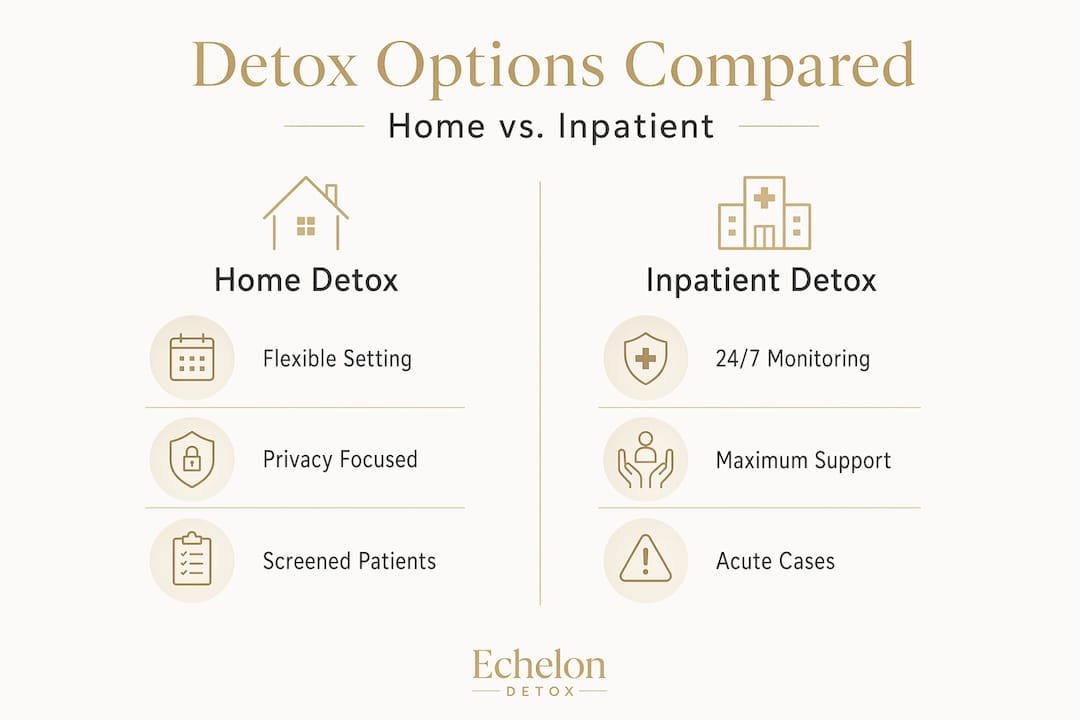
Inpatient detox provides round-the-clock medical supervision for patients whose withdrawal severity or instability requires continuous monitoring and real-time protocol adjustments. That level of care exists for a reason. It is the right choice when the clinical picture is severe or uncertain.
Home detox is appropriate for individuals who meet specific criteria after thorough clinical screening. Outpatient detox, by contrast, offers periodic clinical contact without continuous oversight, which can be insufficient when withdrawal trajectories are unpredictable.
| Setting | Level of supervision | Best suited for | Privacy level |
|---|---|---|---|
| Inpatient detox | 24/7 continuous monitoring | Severe withdrawal, prior DTs, complex medical history | Moderate |
| Home detox | Physician-directed, nurse-present visits | Low to moderate risk, clinically stable, screened patients | High |
| Outpatient detox | Scheduled appointments only | Very low risk, mild withdrawal history | Moderate to high |
The decision is fundamentally a risk management calculation. Safety takes precedence over comfort where withdrawal severity is unpredictable. A reputable home detox provider will tell you honestly if you are not a candidate. That transparency is itself a quality indicator.
Pro Tip: Prior withdrawal history is the single most predictive factor for DTs risk. If you have ever had a seizure or significant confusion during alcohol withdrawal, that history must be disclosed to any clinical team before a home detox plan is created.
How to evaluate and select a home detox provider
The South Florida market includes providers with very different standards of care. These questions will help you distinguish medically credible programs from those offering comfort without clinical substance.
- What are the credentials of the physicians and nurses on your team? Look for licensed MDs or DOs with addiction medicine or emergency medicine backgrounds, supported by registered nurses with clinical detox experience.
- What withdrawal risk assessment tools do you use? Validated instruments such as the CIWA-Ar for alcohol withdrawal should be part of any evidence-based protocol.
- What is your emergency transfer protocol? A clear, pre-planned process for escalation to an emergency facility is non-negotiable.
- How do you handle billing to protect my privacy? Direct-pay options that bypass insurance filings protect against disclosure through claims records.
- What Part 2 compliance procedures do you follow? Ask to see written policies, not just verbal assurances.
- What does post-detox care coordination look like? Detox is clinical stabilization, not a complete treatment. Providers who offer a clear step-down pathway to residential or outpatient support signal a genuine commitment to your recovery, not just the immediate engagement.
- Have you worked with executive clients before? Experience with professionals who have complex privacy, scheduling, and professional continuity needs is a meaningful differentiator.
Florida's Marchman Act also creates urgency around timely detox initiation, as involuntary assessments can be sought by family members within 72 hours when safety concerns arise. Proactively engaging a home detox provider before a crisis reaches that point gives you control over the process and the setting.
My perspective on what actually drives executives to home detox
I have worked closely with enough South Florida executive clients to say this plainly: the thing that keeps most people from getting help is not denial of the problem. It is a specific, rational fear about what seeking help will cost them professionally and socially.
Conventional detox wisdom often assumes that inpatient is always safer. In my experience, that framing misses something important. The safest detox is the one the patient actually completes under medical supervision, not the one they delay indefinitely because the setting is unacceptable to them. Home detox, when executed with real clinical rigor, removes that barrier without compromising medical standards.
What I have seen go wrong is not usually in the clinical design. It is in the privacy gaps. A provider who understands medical detox protocol but handles billing carelessly, or whose intake staff communicate through channels the client did not control, creates exposure that damages trust and sometimes derails the process entirely.
The future of executive detox in South Florida is not about more amenities. It is about providers who understand that clinical excellence and operational discretion are equally weighted priorities for this population. Boutique programs that integrate both are the ones achieving genuinely good outcomes.
— Nichol
Start your private, medically supervised home detox
If you are evaluating home detox options for yourself or someone close to you, the conversation starts with an honest clinical assessment, not a sales pitch.

Echelondetox provides physician-guided, 24/7 in-home detox care for executives and professionals across South Florida and nationwide. Every plan is built around your specific health history, withdrawal risk profile, and privacy requirements. The clinical team includes licensed physicians and registered nurses with direct experience supporting high-functioning professionals through alcohol and drug detoxification. There are no institutional settings, no insurance disclosures without your explicit consent, and no compromise on medical standards. To learn more about how a private home detox can be structured around your needs, reach out to Echelondetox directly for a confidential consultation.
FAQ
What makes home detox safe for executives?
Home detox is safe when it includes physician-directed care, validated withdrawal risk screening, and a clear emergency transfer protocol. Without these elements, it carries serious medical risk, particularly for alcohol withdrawal.
How does 42 CFR Part 2 protect my detox records?
42 CFR Part 2 applies stricter federal protections to substance use disorder records than standard HIPAA, preventing disclosure to employers, insurers, or legal proceedings without your written consent.
Who is not a candidate for home detox?
Individuals with severe alcohol use disorder, a history of prior seizures or delirium tremens, or significant co-occurring medical instability typically require inpatient detox with continuous clinical monitoring.
How long does medically supervised home detox take?
Acute alcohol withdrawal is typically managed over five to seven days, though the full clinical support period varies based on substance type, withdrawal severity, and individual health history.
Why do South Florida executives prefer home detox over residential programs?
The combination of privacy protections, schedule flexibility, and personalized care makes home detox the preferred option for executives who cannot accept the reputational and professional exposure that inpatient admission can create.