

There is a persistent misconception that detox must happen inside a hospital or residential facility to be safe. For many Washington professionals, that assumption has never been less accurate. Why Washington professionals seek home detox comes down to three converging pressures: career exposure, a strained local hospital system, and the real clinical advances that now make medically supervised, in-home withdrawal management viable. This article explains the medical criteria that determine safe candidacy, compares home and inpatient settings honestly, and gives you practical steps to assess whether physician-guided home detox is right for your situation.
Table of Contents
- Key takeaways
- Why Washington professionals seek home detox
- Medical safety and when home detox is appropriate
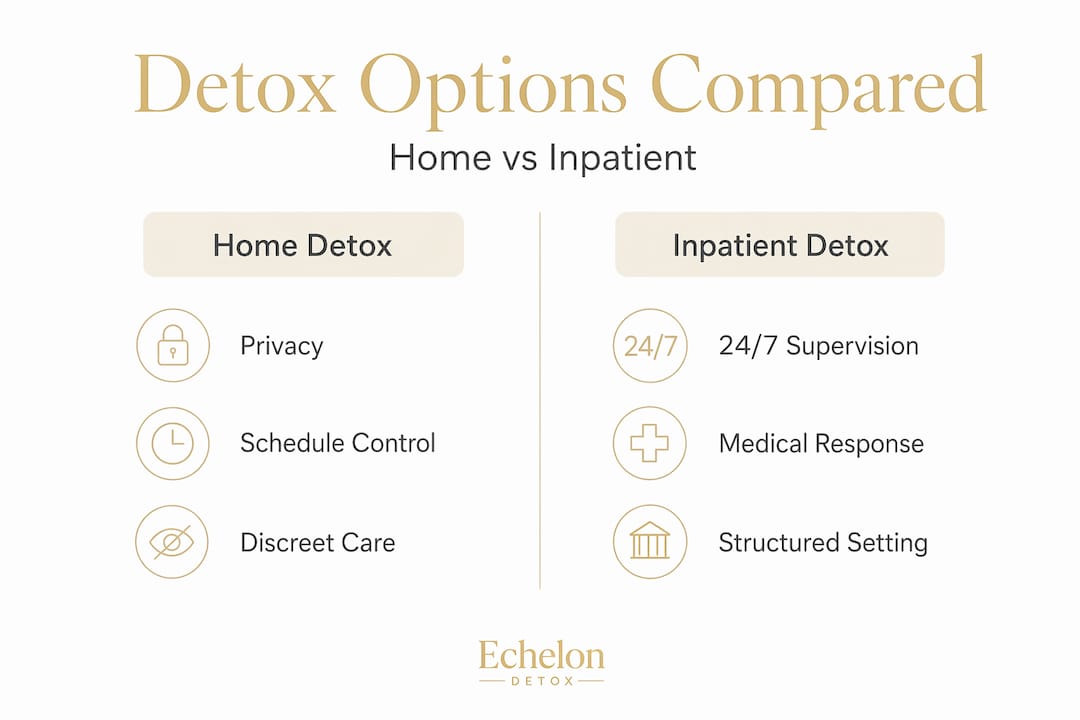
- Home detox versus inpatient detox
- Practical steps for Washington professionals considering home detox
- My perspective on privacy, safety, and getting this right
- How Echelondetox supports Washington professionals
- FAQ
Key takeaways
| Point | Details |
|---|---|
| Privacy drives the decision | Home detox protects career standing and reputation by keeping treatment out of institutional records and public view. |
| Medical oversight is non-negotiable | Safe home detox requires 24/7 physician access, not self-managed withdrawal. |
| Not everyone qualifies | Substance type, withdrawal history, and medical complexity all determine whether home detox is clinically appropriate. |
| Washington's hospital strain matters | Local overcrowding and discharge delays make facility-based detox less predictable for professionals needing a defined timeline. |
| Aftercare must be built in | A home detox plan without integrated follow-up treatment significantly increases relapse risk. |
Why Washington professionals seek home detox
For a Seattle attorney, a Bellevue tech executive, or a Tacoma healthcare administrator, entering a residential detox facility carries risks that have nothing to do with medicine. Word travels. Licensing boards ask questions. Professional networks are small, and discretion is not guaranteed inside shared institutional settings. This is the central reason why Washington high earners prefer home detox over traditional options.
In-home detox reduces stigma in measurable ways, particularly for professionals whose workplace identity is closely tied to personal reputation. When treatment happens at home, there is no intake paperwork filed at a facility your insurer or employer might access, no shared waiting rooms, and no chance of a colleague recognizing you in a hallway.
The specific concerns that drive this preference include:
- Career and licensure risk. Physicians, attorneys, pilots, and financial professionals face regulatory scrutiny when treatment records enter certain systems. Home detox can be structured to minimize that exposure.
- Confidentiality over co-pay disclosures. Many professionals choose to pay privately for home detox rather than file insurance claims that create a paper trail connecting them to substance use treatment.
- Family and schedule continuity. Home detox allows a parent to remain present for children, a spouse to maintain household stability, and a professional to manage critical communications without a complete calendar blackout.
- Control over the recovery environment. Your own home offers familiar surroundings, your own diet, and trusted support people. That predictability reduces anxiety and can support better engagement with the process.
Pro Tip: If privacy is your primary concern, ask any prospective detox provider directly how your health information is stored, whether it is shared with insurers, and what their data security protocols are. A reputable provider will answer this without hesitation.
The stigma around substance use remains real, and it lands harder on professionals who operate in high-accountability roles. Home detox options for busy professionals address that reality head-on, rather than asking you to simply accept the exposure that comes with institutional care.
Medical safety and when home detox is appropriate
The most important question in home detox is not where you want to be. It is whether home-based care can keep you medically safe throughout withdrawal. This distinction is critical.

Withdrawal management varies significantly by substance. Alcohol and benzodiazepine withdrawal carry the highest medical risk, including seizures and delirium tremens, which can be life-threatening without immediate clinical intervention. Opioid withdrawal is rarely fatal but produces intense physical distress that, without support, frequently leads to relapse and subsequent overdose risk. Stimulant withdrawal is generally less medically acute but can involve psychiatric complications requiring monitoring.
Home detox is clinically appropriate under specific conditions. Ambulatory detox is designed for patients who are highly motivated and can be medically monitored at home, with inpatient care reserved for alcohol, sedatives, and complex opiate cases requiring around-the-clock facility-based support. The factors that determine candidacy include:
- Substance type and typical withdrawal severity for that substance
- History of prior withdrawal complications, including any previous seizures or delirium
- Medical and psychiatric comorbidities that could complicate withdrawal management
- Home environment quality, including whether a trusted support person is present
- Patient motivation and compliance history
When those factors align favorably, a physician-directed home detox program can provide continuous supervision that mirrors much of what inpatient care offers, with the added benefits of privacy and environment control.
Washington's hospital system adds a practical layer to this conversation. Roughly 850 patients on any given day across Washington state are medically ready for discharge but face delays due to staffing shortages and insurance barriers. This overcrowding makes facility-based detox timelines unreliable for professionals who need a defined, manageable schedule. Washington professionals often view home detox as more predictable precisely because hospital system delays are a known variable in this state.
Alcohol detox without medical supervision is dangerous. This cannot be overstated. Safe home detox for alcohol dependence requires physician-designed medication protocols, typically involving benzodiazepines for seizure prevention, combined with frequent clinical assessments and a clear escalation pathway to emergency care if symptoms worsen.
Home detox versus inpatient detox
Understanding the real differences between these two settings helps you make a grounded decision rather than one driven purely by preference or fear.
| Feature | Home detox | Inpatient detox |
|---|---|---|
| Privacy | High. Treatment stays out of institutional settings. | Limited. Shared facility, staff, and intake records. |
| Medical monitoring intensity | High with structured programs; lower with unvetted providers. | Highest. 24/7 nursing and physician presence on-site. |
| Schedule flexibility | Maintained. Work and family continuity possible. | None. Full removal from daily life required. |
| Environmental control | Familiar, self-chosen surroundings. | Standardized facility environment. |
| Suitability for complex cases | Conditional. Not appropriate for high-risk withdrawal profiles. | Appropriate for all risk levels including high-severity cases. |
| Cost structure | Often private pay; no insurance paper trail. | May use insurance; creates treatment record. |
The honest limitation of home detox is that it requires a genuinely qualified medical team, not a loosely supervised arrangement. Home detox programs are medical processes with continuous supervision, not self-managed withdrawal. Professionals who attempt withdrawal alone, without physician oversight and medication protocols, face serious risks regardless of how mild they believe their dependence to be.
Inpatient detox remains the right choice when withdrawal risk is high, when a prior home attempt has failed, or when psychiatric instability requires constant monitoring. There is no stigma in recognizing that. The goal is safety, and for some cases, only an inpatient setting provides the clinical infrastructure that goal requires.
Pro Tip: When evaluating any home detox program, ask specifically what the escalation protocol is if your symptoms worsen overnight. A credible program has a written answer and a direct physician line, not a general call center.
The advantages of home detox programs are real and clinically meaningful. But they apply only within the appropriate risk tier. Matching the level of care to your actual clinical profile is the decision that matters most.
Practical steps for Washington professionals considering home detox
If you are exploring home-based medical detox, here is a structured approach to assessing your options and preparing for a safe outcome.
-
Request a formal intake assessment. Any legitimate program begins with a thorough clinical evaluation covering your substance use history, withdrawal history, current medications, and overall health. This is not a formality. The intake risk assessment includes substance type, prior withdrawal complications, medical and psychiatric comorbidities, and your home environment. Requests can be declined for safety reasons, and that is the right outcome when home detox is not appropriate.
-
Ask about the physician's role. Confirm that a licensed physician, not only a nurse or counselor, designs your medication protocol and is reachable 24/7. Ask whether the physician has specific experience with withdrawal management for your substance type.
-
Clarify the escalation plan. You need to know, before detox begins, exactly what happens if symptoms escalate. Which hospital do you go to? Who makes that call? How quickly can emergency care be coordinated?
-
Prepare your home environment. Identify one trusted person who can stay with you or be nearby during the most acute withdrawal phase. Remove access to substances. Have a quiet, comfortable space set up in advance. These environmental factors directly affect clinical outcomes.
-
Coordinate your schedule honestly. Most home detox programs for alcohol or opioids require 5 to 10 days of significant physical and cognitive impairment. Plan for that window with your work calendar. Trying to run a full workday during active detox is neither safe nor realistic.
-
Build aftercare into the plan from day one. Medical oversight is essential beyond detox itself. Completing withdrawal is the beginning of recovery, not the end. A home detox program that ends at medical stabilization without connecting you to ongoing clinical support is incomplete. Ask what happens on day 10.
Detox options for busy professionals increasingly include integrated aftercare coordination, which is what separates a complete clinical program from a short-term medical service.
My perspective on privacy, safety, and getting this right
I have seen professionals come to the home detox conversation from two very different directions. Some arrive with a clear-eyed understanding of their situation and a genuine question about whether home-based care is clinically viable for them. Others arrive having convinced themselves that privacy and convenience justify bypassing a proper medical assessment. That second group worries me.
The value of home detox for Washington professionals is real. I believe deeply that privacy concerns in this population are legitimate and that the stigma around treatment in institutional settings creates a genuine barrier to seeking help. Those concerns deserve to be taken seriously, not dismissed.
What I have also learned is that professionals balance safety and discretion in ways that sometimes lead them to understate symptom severity during intake assessments because they want to qualify for home care. That instinct is understandable and dangerous. A physician who is designing your withdrawal protocol needs accurate information to keep you safe. Understating your history to influence the clinical recommendation is the one choice in this process that can cost you everything.
My strongest recommendation is this: find a physician who specializes in withdrawal management, give them the complete truth, and trust the clinical judgment that follows. If home detox is appropriate, you will know it because the evidence supports it, not because you negotiated your way there. If inpatient care is what the assessment recommends, that recommendation comes from the same place of genuine care.
The private alcohol detox guide for Washington residents reinforces this point well. Privacy and safety are not opposing values. They coexist best when medical expertise is genuinely directing the process.
— Nichol
How Echelondetox supports Washington professionals

Echelondetox was built precisely for professionals who need both clinical rigor and genuine discretion. Their physician-directed model provides 24/7 in-home care through licensed physicians and nurses, with every detox plan customized to your health history, substance profile, and recovery environment. There is no shared facility, no institutional intake record, and no compromise on the medical standards that keep you safe.
If you are a Washington professional weighing your options, the right next step is a confidential clinical assessment. Explore Echelon Detox's home detox services to learn how their concierge model aligns privacy, flexibility, and medically supervised care in a way that respects both your health and your life.
FAQ
What makes home detox medically safe for professionals?
Safe home detox requires physician-designed medication protocols, 24/7 clinical access, and a written escalation plan for emergencies. It is not self-managed withdrawal but a structured medical process with continuous supervision.
Who qualifies for home detox in Washington?
Candidacy depends on substance type, withdrawal history, medical and psychiatric complexity, and home environment. High-risk cases involving alcohol or benzodiazepine dependence with prior complications typically require inpatient care.
Why do Seattle executives choose in-home detox over residential programs?
Privacy protection, career continuity, and schedule control are the primary drivers. Home-based programs keep treatment out of institutional records and allow professionals to manage critical responsibilities during a defined recovery window.
How does Washington's hospital system affect detox decisions?
Chronic overcrowding in Washington hospitals creates unpredictable timelines for facility-based care. With roughly 850 patients facing discharge delays on any given day, professionals often find home detox more reliable for planning purposes.
Does home detox work for alcohol withdrawal specifically?
Yes, but only under strict medical supervision. Alcohol withdrawal carries serious risks including seizures, and safe home-based management requires physician-prescribed medications, frequent assessments, and immediate access to emergency escalation if symptoms worsen.